

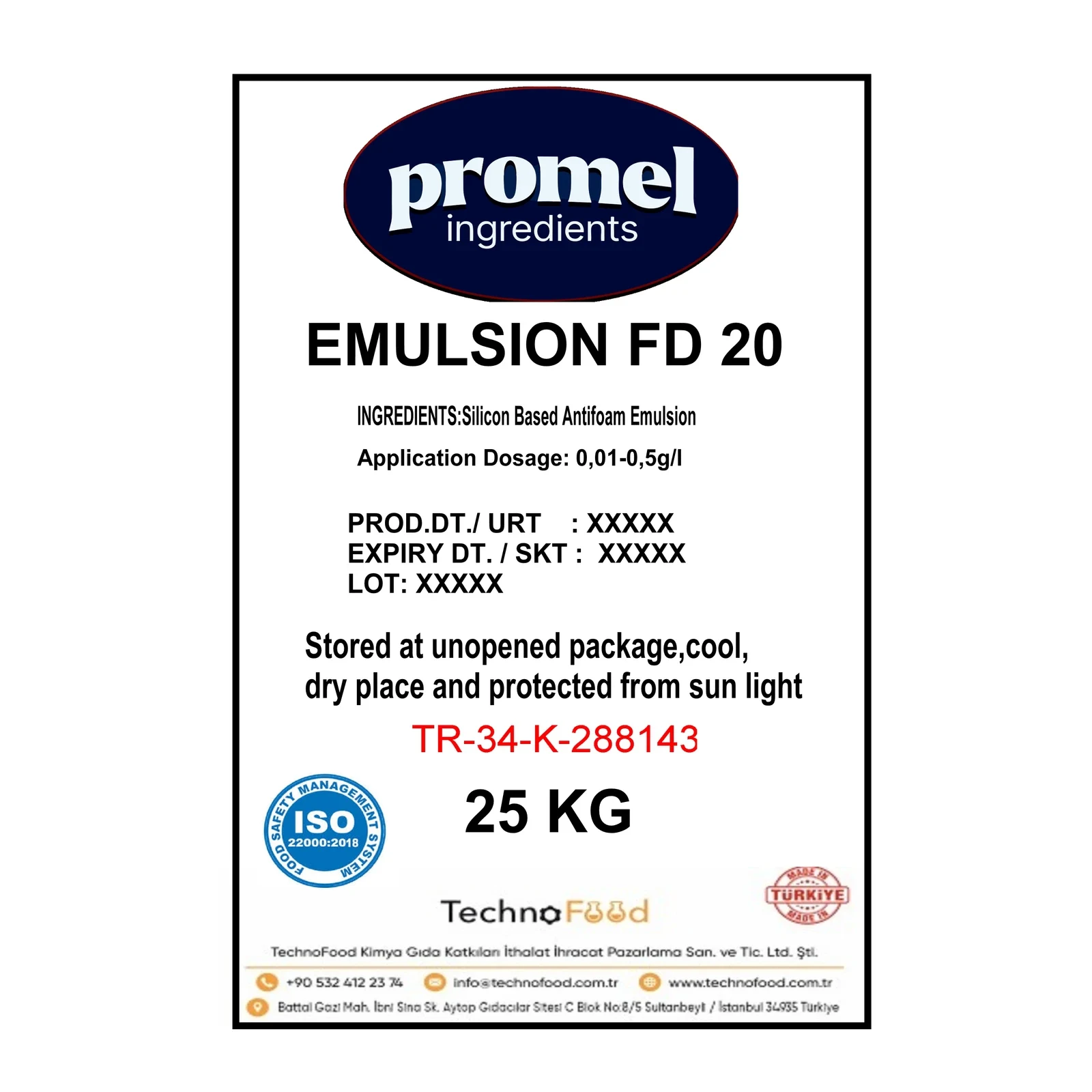
Promel Antifoam
Promel Antifoam is a silicone-based antifoam emulsion that knocks down foam generated during dairy processing and limits its recurrence; it disperses readily in both hot and cold aqueous systems.
Product description
Foam is a common problem in dairy plants, frequently encountered at points such as whey collection and pumping, milk reception, tank filling, ayran (yogurt drink) and fermented beverage filling, evaporators, and CIP return lines. Foam reduces effective tank capacity, causes overflow and product loss, misleads level sensors, and compromises filling accuracy.
Promel Antifoam is a silicone-based, white-to-cream liquid antifoam emulsion designed to address these issues. It is used at very low dosages as a processing aid.
Technical function and working principle
Milk proteins — particularly whey proteins and caseins — adsorb at the air–liquid interface, forming a resilient film around bubbles; consequently, foam forms readily in dairy systems and persists for extended periods. Polydimethylsiloxane, the active component of silicone-based antifoams, has a very low surface tension and is insoluble in water. Droplets released from the emulsion enter the foam lamella, spread rapidly across the surface, and displace the protein film, causing it to thin; the lamella ruptures and the bubble collapses.
The emulsion form ensures rapid, homogeneous dispersion of the silicone in aqueous systems. The product disperses completely in both hot and cold aqueous systems with only gentle agitation.
Applications
- Whey collection tanks, pumping and transfer lines
- Cheese vats and serum drainage after curd formation
- Milk reception and tank filling
- Filling of ayran (yogurt drink) and drinkable fermented milk products
- Evaporator and concentration lines
- Plant-based cheese alternatives and other food processes
Key benefits
- Rapid knockdown of existing foam and suppression of re-formation
- Effective at very low dosages
- Full utilisation of tank capacity, reduced overflow and product loss
- Improved level measurement and filling accuracy
- Easy dispersion in hot and cold systems
- Allergen-free formulation
Usage and dosage
The recommended label dosage is in the range of 0.01–0.5 g/L. The product can be added directly to the foaming system; for more homogeneous distribution and precise dosing, it is recommended to dilute with soft or deionised water and prepare with slow agitation. Diluted product should be used within 12 hours. In continuous processes, dosing via a metering pump close to the point of foam formation gives the best results.
Antifoams are used as processing aids; the legal status regarding residue levels in the finished product and product category must be assessed in accordance with the Turkish Food Codex and applicable regulations. Excessive dosage may cause an oily appearance or film formation on the surface. The optimum dosage should be determined through pilot trials based on the process and the point of foam generation.
Technical specifications
| Parameter | Value |
|---|---|
| Appearance | Liquid (emulsion) |
| Colour | White – off-white |
| Viscosity (25 °C) | 1500 – 5000 cP |
| Non-volatile matter | 28 – 32 % (w/w) |
| pH | 5.0 – 9.0 |
| Cadmium, mercury, arsenic, lead | Max. 1 ppm each |
| Fluoride | Max. 10 ppm |
| Allergen | Free from EU-listed allergens |
| GMO | GMO-free |
| Halal compliance | Compliant with OIC/SMIIC 1:2019 |
| Shelf life | 1 year |
Packaging and storage
Drum packaging. Store in the original unopened packaging in a clean, dry area at ambient temperature, away from odorous materials and protected from direct sunlight. Protect from freezing, as frost may destabilise the emulsion.
Frequently asked questions
Does the antifoam affect the taste of the finished product?
No impact on taste or odour is expected at the recommended dosages. The product should be stored away from odorous materials.
Can it be used in whey powder production?
It can be used for foam control in evaporator and concentration lines; if the customer's specification for the final powder includes a silicone residue limit, this should be evaluated in advance.
Why must the diluted product be used within 12 hours?
Dilution reduces the stability of the emulsion; prolonged standing may lead to phase separation and increased microbial load. It is recommended to dilute only the quantity needed for daily use.
Technical support
For assistance with the addition point, dilution ratio, and metering pump settings for the antifoam in your process, please contact the Technofood technical team to request support and samples.