

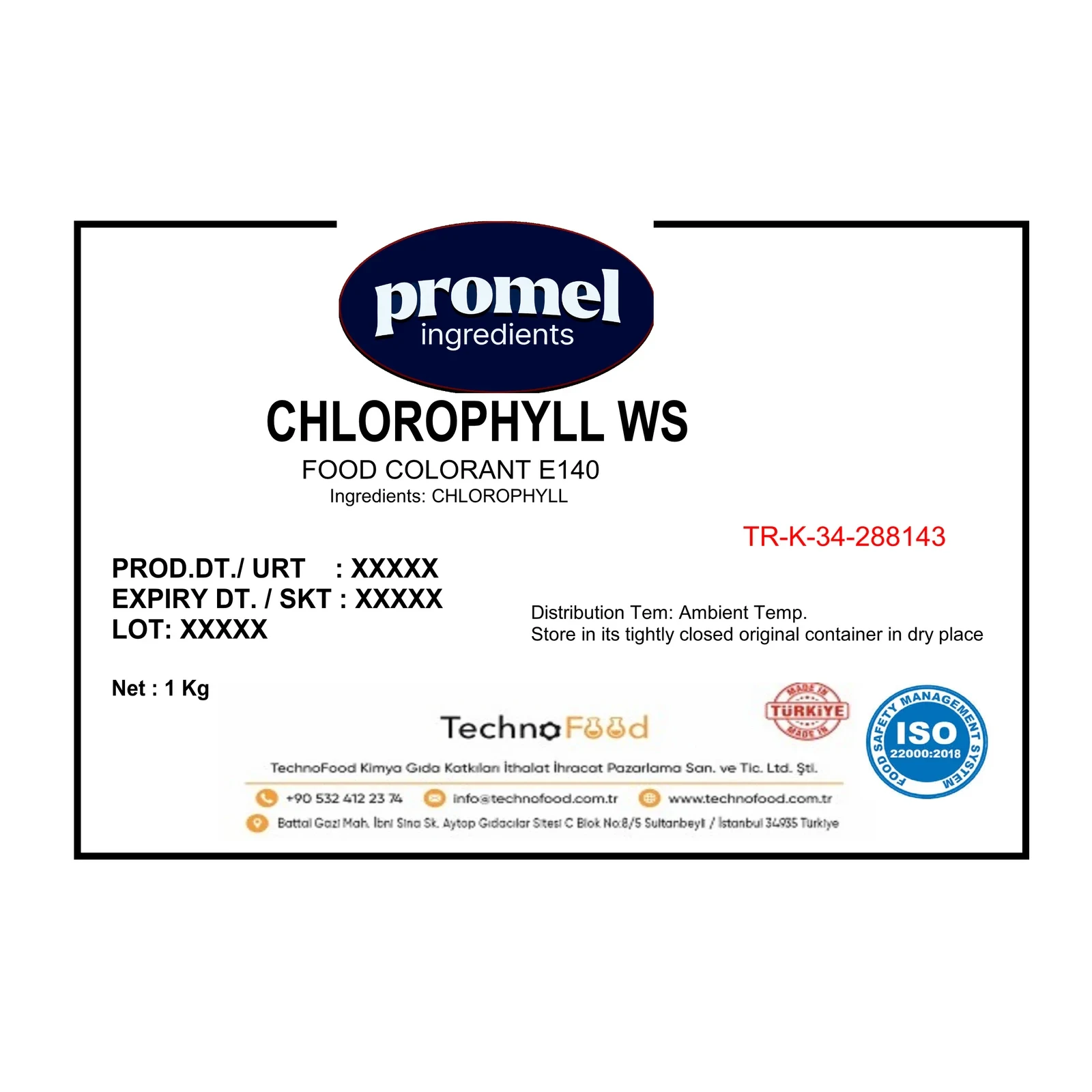
PROMEL CHLOROPHYLLIN
Water-soluble liquid chlorophyllin food colour; used to impart and adjust green shades in ice cream, flavoured fermented milk products and herb/spice cheeses.
Product description
Promel Chlorophyllin is a water-soluble liquid green food colour derived from plant chlorophyll. Chlorophyllin is obtained by saponification of the chlorophyll molecule, which removes the phytol chain and renders the pigment directly soluble in water-based systems—unlike fat-soluble chlorophyll. As food additives, chlorophylls and chlorophyllins are designated E 140, while their copper complexes are designated E 141.
The product is used to create green shades that complement flavours such as pistachio, mint and green tea in dairy products, to support the green appearance in herb and spice cheeses, and to balance colour tones at low dosages in certain applications.
Technical function and working principle
The green colour of chlorophyllin originates from the porphyrin ring with a central metal ion. In natural chlorophyll the central ion is magnesium; magnesium is readily displaced by acid and heat, causing the colour to shift to olive-brown. In copper-complex forms (E 141) the central ion is copper; these forms are significantly more resistant to heat and light and retain a bright green colour.
Chlorophyllin salts are stable under alkaline conditions; the product pH is in the range 12–14. In acidic conditions (below approximately pH 4–5) the solubility of chlorophyllin decreases, potentially causing sedimentation or a speckled appearance. This is a critical point that must be tested before use in yogurt and fermented milk products, which typically have a pH of 4.2–4.6.
Applications
- Ice cream and milkshakes (with pistachio, mint, green apple and similar flavours)
- Flavoured fermented milk products and milk-based desserts (pH compatibility must be tested)
- Herb, spice or pesto-type cheeses and spreadable cheeses
- Plant-based cheese alternatives
Benefits
- Water-soluble liquid form: direct, homogeneous addition to the aqueous phase
- Pronounced green colour at very low dosages
- Alignment of colour perception with flavour (e.g. the expected green shade in pistachio ice cream)
- Greater colour stability under heat treatment and light exposure in copper-complex forms
Usage and dosage
Chlorophyllin has high tinctorial strength; the dosage should be determined incrementally against a standard sample according to the target colour. Product-specific dosage is provided in the technical data sheet (TDS).
- In ice cream, the food colour can be added to the mix before pasteurisation or in the ageing tank.
- In fermented products, the colour should be added after fermentation and monitored for sedimentation at the final product pH throughout the shelf life.
- In cheese applications, it must be verified in advance whether the product category permits the use of food colours.
- As an alkaline solution, contact with skin and eyes must be avoided; personal protective equipment should be worn.
Optimum dosage should be determined through pilot trials based on raw materials and formulation.
Technical specifications
| Parameter | Value |
|---|---|
| Appearance | Liquid |
| Colour / odour | Characteristic |
| Solubility | Water-soluble |
| pH | 12.0–14.0 |
| Density | 0.980–1.080 g/cm³ |
| Hazard classification | Not classified as hazardous according to (EC) 1272/2008 |
Values are taken from the safety data sheet (SDS). The technical data sheet (TDS) is available on request.
Packaging and storage
Store in tightly sealed, light-proof packaging in a cool place. The product is intended solely for industrial food production and is not suitable for direct consumption.
Frequently asked questions
What is the difference between chlorophyll and chlorophyllin?
Chlorophyll is fat-soluble and contains a central magnesium ion; it readily turns brown under heat and acidic conditions. Chlorophyllin is the water-soluble form obtained by removal of the phytol chain; its copper-complex variants are far more resistant to heat and light.
Can it be used in yogurt?
The acidic pH of yogurt may cause chlorophyllin to precipitate. Before use in flavoured fermented products, a stability test must be carried out at the final product pH; in addition, it should be confirmed that the product category permits the use of food colours.
Can it be used in white brined cheese?
The use of food colours is restricted by legislation according to the cheese category. Before use in white brined cheese, the provisions of the Turkish Food Codex Food Additives Regulation and the Cheese Communiqué must be checked; use in non-permitted categories is not allowed.
To evaluate colour shade and pH stability in your ice cream, fermented product or cheese application, request samples and application support from the Technofood technical team.