

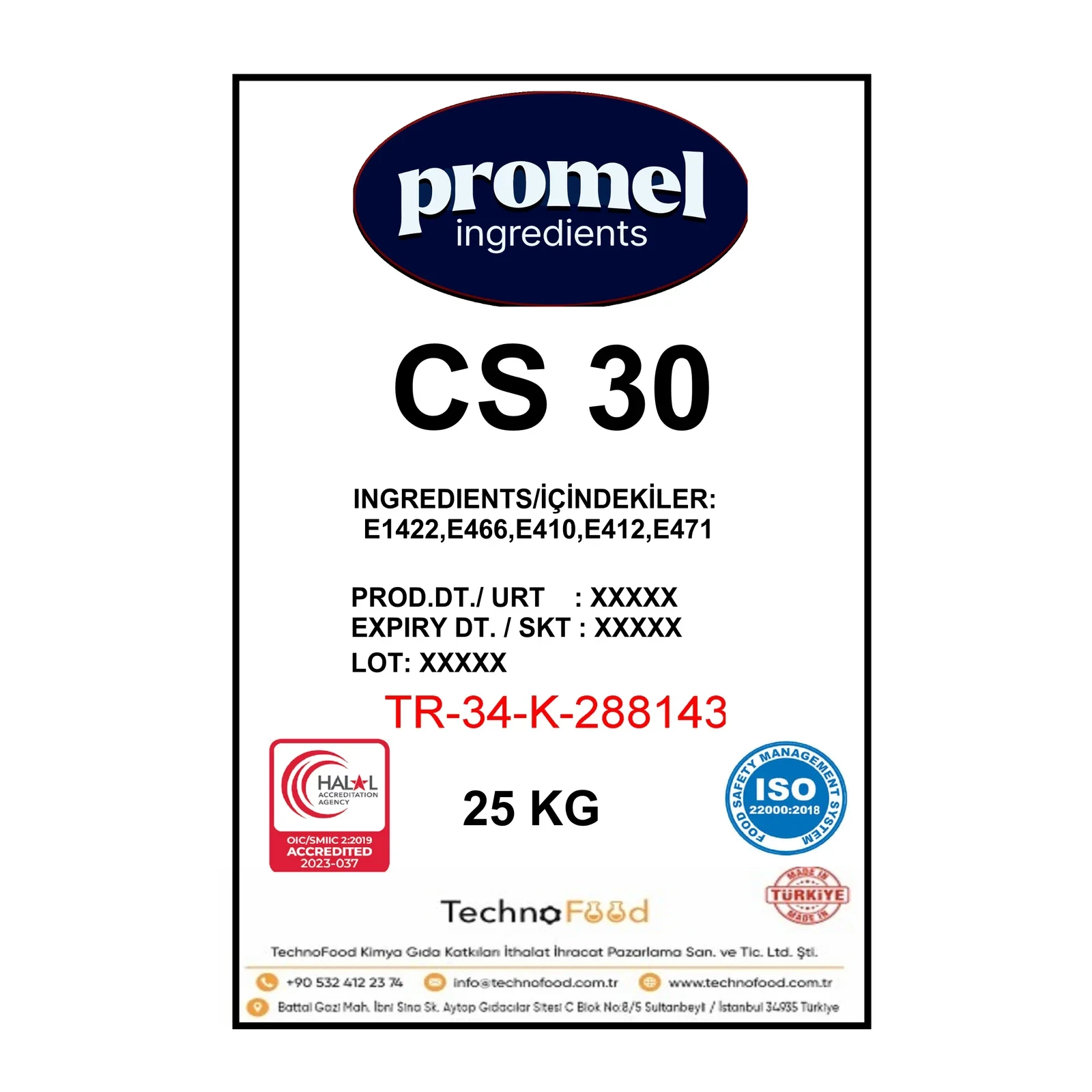
PROMEL CS 30
PROMEL CS 30 is a stabiliser and emulsifier blend designed for cheese sauce production, delivering body, heat stability and resistance to oiling-off.
Product description
PROMEL CS 30 is a powdered stabiliser and emulsifier blend designed for the production of cheese sauce and cheese-based fillings. It contains modified starch (acetylated di-starch adipate, E1422), sodium carboxymethyl cellulose (E466), carrageenan (E407), guar gum (E412) and mono- and diglycerides of fatty acids (E471). The product is engineered to maintain consistency and prevent fat-phase separation in sauces that are hot-filled, subsequently reheated or oven-baked.
Unlike block cheese, a cheese sauce is an emulsion that must remain fluid. Starch retrogradation, protein aggregation and oiling-off are common defects encountered during heating, cooling and reheating cycles. CS 30 addresses all three issues through its distinct functional components.
Technical function and working principle
Modified starch (E1422): Thanks to its cross-linked and acetylated structure, it resists granule breakdown during cooking and mixing; its tendency to gel and release water (retrogradation) on cooling is significantly lower than that of native starch. It gives the sauce body and a creamy mouthfeel, maintaining consistency through freeze–thaw and reheating cycles.
CMC and guar gum: These two cold-soluble thickeners increase the viscosity of the continuous phase, slowing the migration of fat droplets and solid particles and regulating sauce flow.
Carrageenan: Interacts with milk proteins to form a weak gel network, ensuring the sauce does not become fully fluid on cooling but instead develops a soft, spoonable texture.
Mono- and diglycerides (E471): These emulsifiers position themselves at the oil–water interface, limiting coalescence of fat droplets, reducing the formation of surface oil rings on reheating and delivering a glossier, more homogeneous appearance.
Applications
- Cheddar-type and white cheese sauces
- Hot sauces for nachos, pasta and baked potatoes
- Cheese fillings and creams for oven-baked products
- Cheese sauce components for ready meals and frozen products
- Vegetable-fat-based sauce and filling analogues
Benefits
- Consistency retained through cooking, hot filling and reheating
- Reduced oiling-off and surface fat accumulation
- Limited syneresis and skin formation after cooling
- Smooth, creamy mouthfeel and glossy appearance
- Single-ingredient dosage of stabiliser and emulsifier; simplified formulation and inventory management
Usage and dosage
The usage rate varies according to the cheese, fat and dry matter content of the formulation; for complete systems of this type, the typical starting range is 1–3 % based on the finished product. To prevent lumping, the product should be pre-blended with dry ingredients such as sugar, milk powder or salt, or sprinkled slowly into water under high-shear mixing. The sauce must be brought to cooking temperature (typically 85–90 °C) and held for several minutes to ensure full starch gelatinisation. In cheese sauce formulations containing emulsifying salts, CS 30 does not replace the emulsifying salt; it complements it.
Optimum dosage should be determined by pilot trials based on the specific raw materials and formulation. Usage must comply with the conditions set out in the Turkish Food Codex Food Additives Regulation for sauce and related dairy product categories.
Technical specifications
| Parameter | Value |
|---|---|
| Appearance | Powder |
| Colour | White |
| Odour / taste | Free from foreign odour and taste |
| Loss on drying | < 15 % |
| pH | 4.5–7.0 |
| Ingredients | E1422, E466, E407, E412, E471 |
Packaging and storage
25 kg kraft bag. Store in its sealed packaging in a cool, dry and well-ventilated area. The product is hygroscopic; protect from moisture. Shelf life is 2 years from the date of manufacture.
Frequently asked questions
Can CS 30 be used instead of emulsifying salt?
No. The emulsifying salt dissolves the cheese protein and establishes the foundation of the emulsion, while CS 30 supports that emulsion in terms of consistency, heat resistance and fat stability. In sauces with a high cheese content, both are used together.
What should be done if the sauce releases fat on reheating?
First check whether the cooking temperature and time are sufficient for full starch gelatinisation. Insufficient cooking and a low emulsifier level are the most common causes of oiling-off; dosage adjustment should be trialled at pilot scale.
Can it be used in acidic sauces?
The product's own pH range is 4.5–7.0 and the modified starch is resistant to moderate acidity. As viscosity behaviour may change in distinctly acidic formulations, preliminary trials are recommended.
Can it be used in frozen products?
Yes. The acetylated starch and gum components limit syneresis during freeze–thaw cycles; however, stability testing under final product conditions is still recommended.
To optimise consistency, flow and fat stability in your sauce formulation, contact our technical team and request a PROMEL CS 30 sample.