

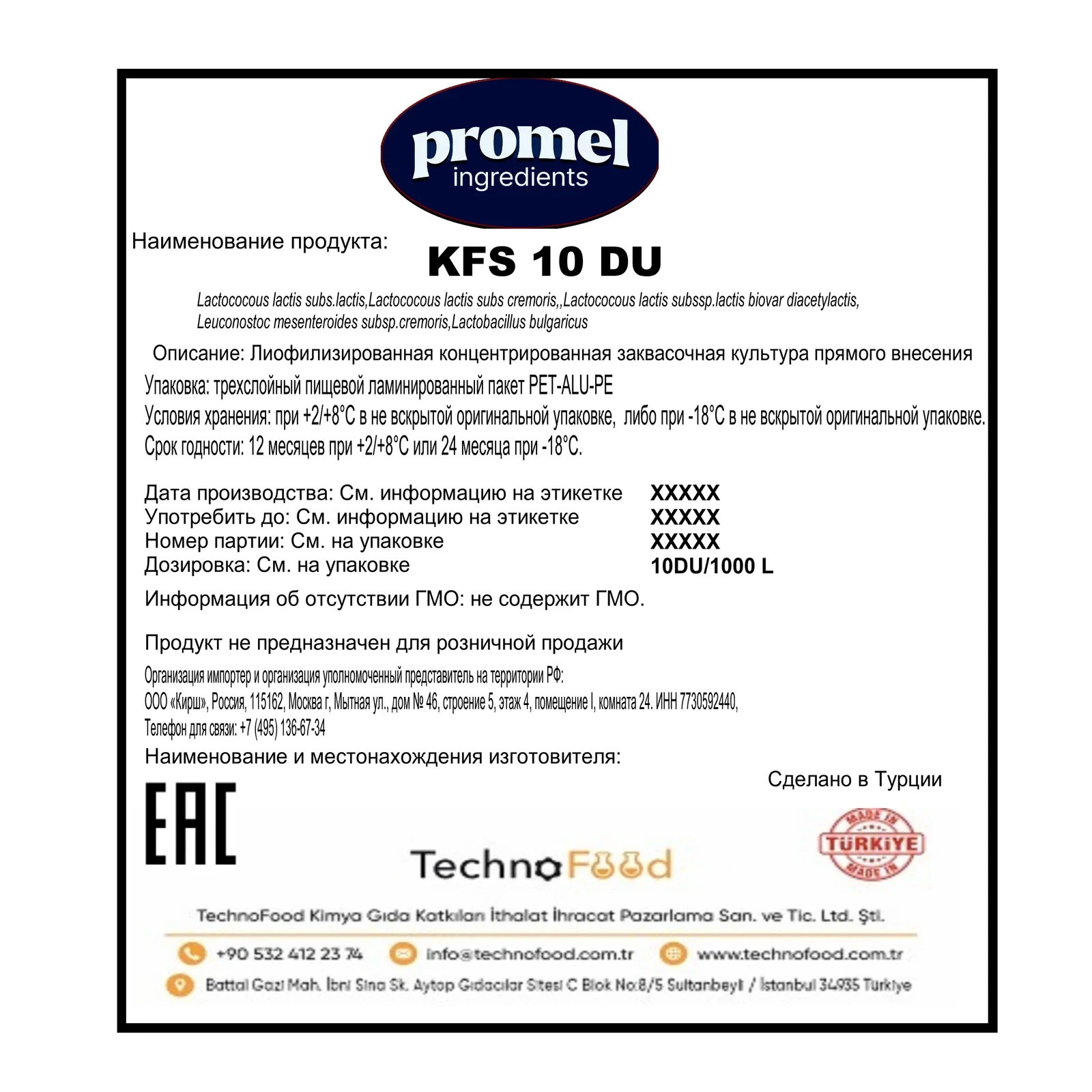
PROMEL F.D.Starter Culture KFS (10DU)KEFIR30
Promel KFS (Kefir30) is a freeze-dried kefir starter culture derived from kefir grain flora, containing lactic acid bacteria and yeasts for direct addition to milk; supplied in 10 DU packs.
Product description
Kefir is a fermented milk product traditionally produced with kefir grains, in which lactic acid fermentation and yeast-derived alcohol fermentation take place simultaneously. Kefir grains are a complex symbiotic community of lactobacilli, lactococci, Leuconostoc species, acetic acid bacteria, and both lactose-fermenting and non-lactose-fermenting yeasts, all embedded in a polysaccharide matrix known as kefiran.
Working with grains on an industrial scale is challenging: the labour involved in separating, washing and feeding the grains, combined with the variable flora from batch to batch, makes it difficult to achieve a consistent product. Promel KFS is a freeze-dried, direct vat set (DVS) kefir culture designed to address this need: it enables kefir production with the same starting flora in every batch, without the use of grains.
Technical function and working principle
Mesophilic lactic acid bacteria convert lactose into lactic acid, lowering the pH and inducing casein coagulation. Citrate-fermenting lactococci and Leuconostoc species produce aroma compounds such as diacetyl, along with CO₂. What distinguishes kefir is its yeast fraction: yeasts generate small amounts of CO₂ and ethanol, giving the product its characteristic slightly effervescent, refreshing taste with yeast notes. A mutual nutritional relationship exists between bacteria and yeasts, involving the exchange of vitamins, amino acids and organic acids.
Fermentation proceeds at lower temperatures compared to yogurt, resulting in a softer, more fluid and drinkable curd.
Applications
- Drinkable kefir (plain and fruit-flavoured)
- Kefir-based fermented milk beverages
- Base for lactose-reduced fermented milk products
- Kefir-style frozen desserts and smoothie bases
Advantages
- Continuous production without the need for kefir grain maintenance and separation
- More consistent acidity, aroma and gas profile from batch to batch
- Direct inoculation eliminates bulk starter preparation and bacteriophage risk
- Typical kefir character with refreshing acidity, gentle effervescence and yeast notes
- Easy storage and inventory management in freeze-dried form
Usage and dosage
After the milk has been standardised and homogenised, it is typically heat-treated at 90–95 °C for 5–10 minutes, then cooled to incubation temperature. The sachet is opened, the contents are sprinkled onto the milk surface and briefly stirred in.
Incubation with kefir cultures is typically carried out at 20–30 °C, targeting a pH of approximately 4.4–4.6. Once the curd has formed, the product is gently stirred and cooled. Some producers apply a cold ripening step of several hours to one day to allow the yeast character to develop; this period should be evaluated together with packaging selection in view of gas formation and aroma development. Shelf life tests should be conducted, as excessive gas in the packaged product can cause lid bulging.
The volume of milk to be inoculated per sachet and the corresponding fermentation time should be adjusted according to the product technical data sheet (TDS). Optimum dosage and incubation conditions should be determined through pilot trials based on the raw materials and formulation.
The technical data sheet (TDS) is available upon request.
Packaging and storage
Freeze-dried cultures are typically stored at −18 °C or below. Once opened, the entire contents of the sachet should be used.
Frequently asked questions
What is the main difference between a kefir culture and a yogurt culture?
Yogurt culture is thermophilic and contains only lactic acid bacteria. Kefir culture contains yeasts in addition to mesophilic bacteria; it therefore ferments at a lower temperature and produces gentle effervescence and yeast notes in the product.
Does it give the same result as kefir produced with grains?
The freeze-dried culture delivers the technologically important members of the grain flora in a standardised ratio. While kefir produced with grains varies from batch to batch, a DVS culture provides reproducibility; however, aroma intensity may be perceived differently compared to grain-produced kefir.
What causes package bloating?
It is caused by yeasts continuing to produce CO₂ during cold storage. Rapid cooling at the target pH, maintaining a low storage temperature and selecting appropriate packaging help reduce this risk.
Technical support
For assistance in determining your kefir formulation, incubation temperature and cold ripening duration with Promel KFS, as well as for sample requests, please contact the Technofood technical team.