

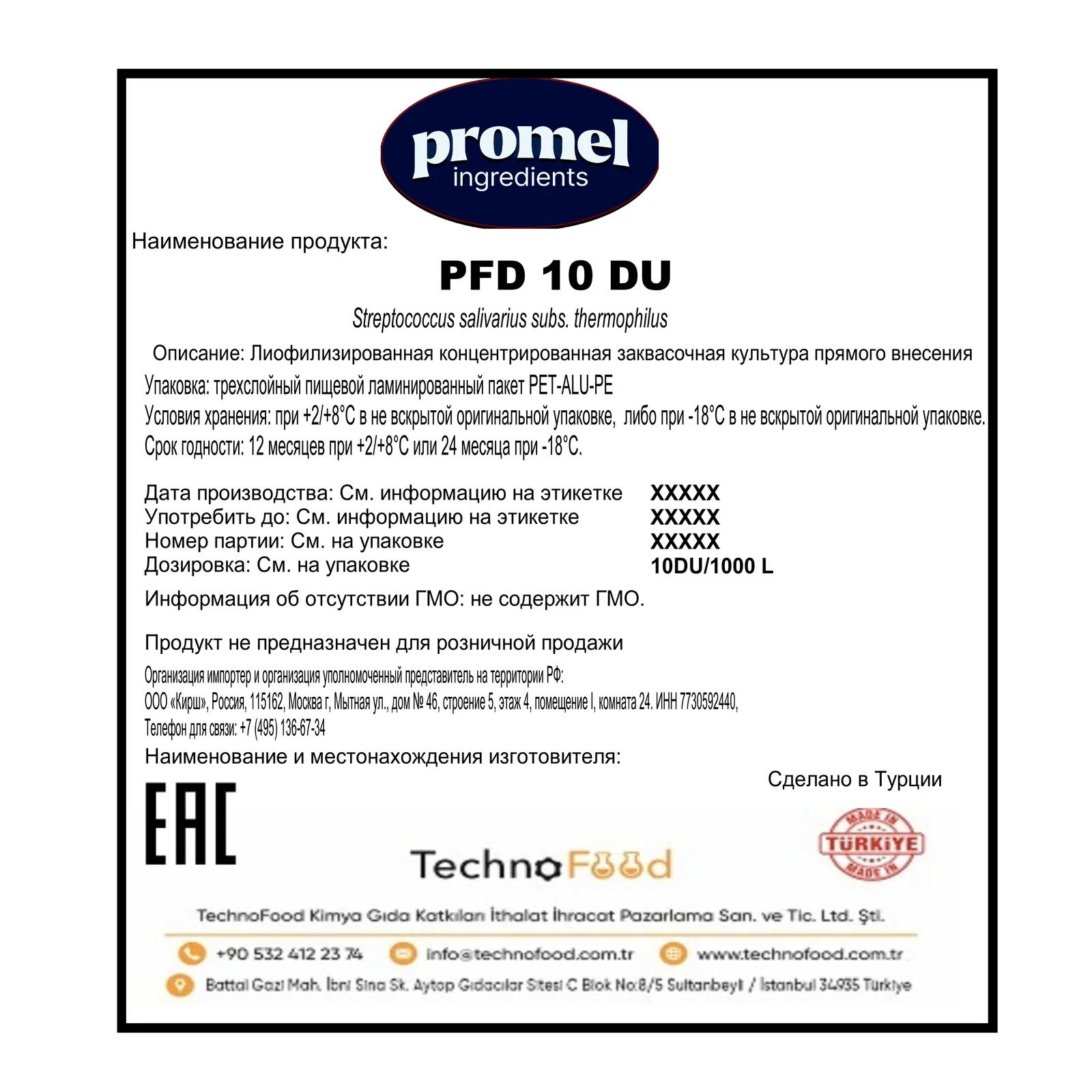
PROMEL F.D.Starter Culture YOLP (10 DU)
Promel YOLP is a freeze-dried thermophilic yogurt culture containing Streptococcus thermophilus and Lactobacillus delbrueckii subsp. bulgaricus, designed for direct vat set (DVS) inoculation; available in 10 DU packs.
Product description
Promel YOLP is a freeze-dried (lyophilised) thermophilic starter culture developed for the production of set and stirred yogurt. The culture is inoculated directly into the process milk without the need to prepare a bulk starter (DVS – direct vat set). This approach eliminates the bacteriophage and contamination risks associated with maintaining a mother culture in the plant, and ensures a consistent strain ratio at the start of every batch.
The product is packaged as 10 DU (units). The unit is an activity measure expressing the acidification capacity of the culture; the volume of milk a single pack will inoculate depends on the target incubation time and temperature.
Technical function and working principle
Yogurt fermentation is based on the protocooperation of two species. L. delbrueckii subsp. bulgaricus, which has higher proteolytic activity, releases peptides and amino acids from casein; these serve as a nitrogen source for S. thermophilus, which grows rapidly at the onset of fermentation. In turn, S. thermophilus produces formic acid, pyruvic acid and CO₂, stimulating the growth of the lactobacillus. Together, the lactic acid produced by both species lowers the pH of the milk to below approximately 4.6; the casein micelles coagulate at their isoelectric point, forming the gel structure of the yogurt.
The characteristic yogurt aroma is largely derived from acetaldehyde; in addition, exopolysaccharides (EPS) produced by certain thermophilic strains increase viscosity and mouthfeel while limiting syneresis (whey separation).
Applications
- Set yogurt (incubated and coagulated in the retail container)
- Stirred and drinking yogurt
- Strained yogurt and labneh-type concentrated products
- Yogurt base for ayran (yogurt drink) production
- Fruit and flavoured yogurts
Key benefits
- DVS format eliminates the need for bulk starter preparation, a culture laboratory and daily transfers
- Reproducible acidification time and final pH from batch to batch
- Reduced risk of bacteriophage attack and contamination by foreign microorganisms
- Characteristic yogurt aroma and balanced acidity
- Ability to control viscosity and curd texture through culture selection
- Extended storage life in freeze-dried form and easy stock management
Usage and dosage
The milk is standardised (dry matter, fat), homogenised and typically heat-treated at 90–95 °C for 5–10 minutes. This step denatures the whey proteins, improving water binding and gel firmness. Once the milk has been cooled to the incubation temperature, the culture pack is opened and its contents are sprinkled directly onto the milk surface, followed by gentle stirring for 5–10 minutes.
Incubation with thermophilic yogurt cultures is typically carried out at 40–45 °C; when the target pH (usually 4.5–4.7) is reached, the product is rapidly cooled to halt fermentation. Higher temperatures favour L. bulgaricus growth and stronger acidity, while lower temperatures promote a milder flavour and longer fermentation time. The volume of milk to be inoculated per pack and the corresponding fermentation time should be adjusted according to the product technical data sheet (TDS).
Antibiotic residues, cleaning agent residues and high somatic cell counts inhibit fermentation; these parameters must be checked at milk reception. Optimum dosage and incubation conditions should be determined through pilot trials based on the raw material and formulation.
The technical data sheet (TDS) is available on request.
Packaging and storage
Freeze-dried cultures must be stored under cold-chain conditions, typically in a freezer (−18 °C or below). Once opened, the pack must be used in full on the same day; moisture and temperature rapidly reduce culture viability.
Frequently asked questions
Can I propagate a DVS culture to prepare a bulk starter?
It is technically possible but not recommended. Successive transfers disrupt the balance between strains, increase bacteriophage risk and negate the reproducibility that DVS use provides.
What should I check if fermentation takes longer than expected?
First check the milk for antibiotic and disinfectant residues, then verify that the incubation temperature is uniform throughout the tank. Storage temperature of the culture and any delay after opening the pack will also reduce activity.
How can I limit post-acidification during cold storage?
Rapid cooling as soon as the target pH is reached is the most effective measure. Post-acidification is largely driven by L. bulgaricus activity; for products requiring low post-acidification, culture selection can be carried out in consultation with our technical team.
Technical support
For determination of the correct inoculation rate for Promel YOLP based on your milk, heat treatment conditions and target texture, evaluation of pilot fermentation curves, or to request a sample, please contact the Technofood technical team.