

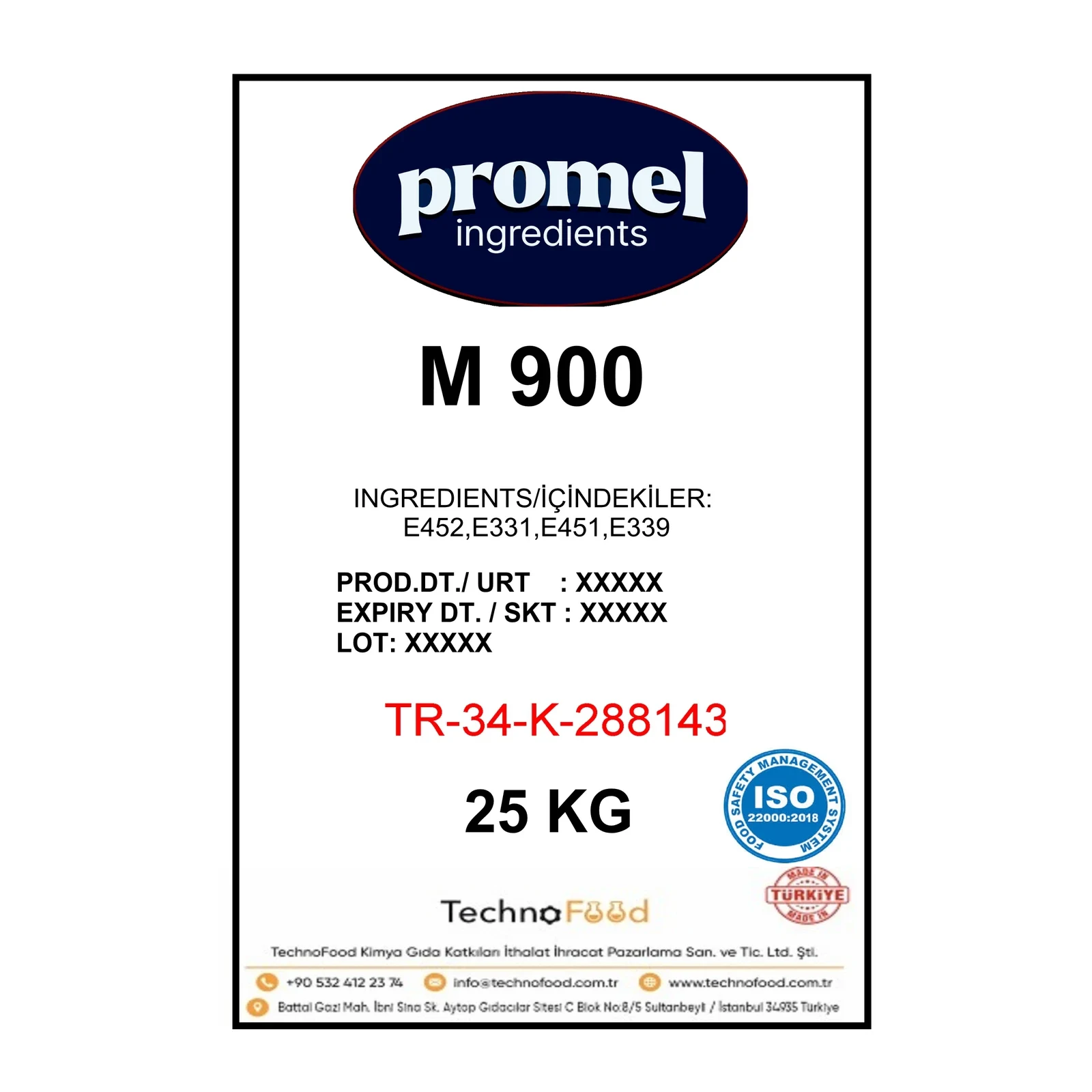
PROMEL M900
PROMEL M900 is a UHT milk stabiliser composed of polyphosphate, triphosphate, sodium citrate and sodium phosphate; by regulating calcium balance, it limits protein sedimentation and phase separation during heat treatment and storage.
Product description
PROMEL M900 is a powdered phosphate–citrate blend developed for UHT and sterilised milk and milk-based beverages. It contains polyphosphate (E452), triphosphate (E451), sodium citrate (E331) and sodium phosphate (E339). It is free from hydrocolloids and works by regulating calcium balance and pH.
The main physical defects observed in UHT milk are fouling on heat-exchanger surfaces during heat treatment, sediment formation at the bottom of the package, protein sedimentation over shelf life and, at a later stage, age gelation. A significant proportion of these problems originates from seasonal and regional variations in the calcium-ion level and salt balance of raw milk. M900 is used to buffer this variability.
Technical function and working principle
Free calcium ions in milk form bridges between casein micelles during heating, leading to aggregation and sedimentation. Citrates and phosphates sequester these ions in complex form (ion exchange and chelation); the negative charge on the micellar surface increases, inter-micellar repulsion is strengthened and the milk becomes more resistant to heat treatment. Scientific studies have shown that citrate sequesters calcium more effectively than orthophosphate, while long-chain polyphosphates delay age gelation in UHT milk. Combining phosphates of different chain lengths with citrate brings together calcium sequestration, pH buffering and protein dispersion effects in a balanced manner.
The slightly alkaline pH of the product (7.6–8.1) contributes to protein stability when the milk pH before heat treatment is low. In products such as chocolate milk and flavoured milk, keeping cocoa particles in suspension requires an additional hydrocolloid (typically carrageenan); M900 should be considered a complementary ingredient that stabilises the protein phase in such systems.
Applications
- UHT and sterilised drinking milk (within regulatory limits)
- Flavoured and chocolate UHT milk beverages
- Calcium- or protein-fortified milk beverages
- Milk-based UHT coffee and beverage blends
Benefits
- Reduced protein aggregation and heat-exchanger fouling during heat treatment
- Limited sediment and protein sedimentation at the bottom of the package throughout shelf life
- Extended physical stability by delaying age gelation
- More consistent production despite seasonal variability in raw milk
- Does not alter the viscosity or mouthfeel of the beverage, as it contains no hydrocolloids
Usage and dosage
The product dissolves easily in water. It is added directly to the milk during standardisation or pre-dissolved in a small amount of water, ensuring homogeneous dispersion before heat treatment. Salts of this type are typically used in UHT milk at a level of a few tenths per mille (approximately 0.05–0.1 %). Excessive dosage may upset the salt balance of the milk, causing bitterness and colour changes.
The use of phosphates and citrates in drinking milk is restricted by the Turkish Food Codex Food Additives Regulation according to product category. Before use, the category of your product and the permitted maximum levels must be verified. The optimum dosage should be determined through pilot trials based on raw-milk quality and formulation.
Specifications
| Parameter | Value |
|---|---|
| Appearance | Powder |
| Colour | White |
| Odour / taste | Free from foreign odour and taste |
| Loss on drying | < 15 % |
| pH | 7.6–8.1 |
| Ingredients | E452, E451, E331, E339 |
Packaging and storage
Store in a cool, dry place in its sealed original packaging, away from moisture. Shelf life is 2 years from the date of manufacture.
Frequently asked questions
Does M900 contain carrageenan?
No. M900 is a phosphate–citrate blend designed to improve the heat stability of the protein phase. A separate suspending hydrocolloid is required to prevent sedimentation of insoluble particles such as cocoa.
Does M900 extend microbiological shelf life?
No. Microbiological safety is ensured by heat treatment and aseptic filling. M900 only improves physical stability—that is, it delays the onset of defects such as sediment, sedimentation and gelation.
When should it be used?
It is beneficial for batches where fouling builds up rapidly in the preheating or UHT section, the alcohol test yields poor results, or sediment forms during shelf life. If the root cause is raw-milk microbiology (proteolytic enzymes), a stabiliser alone is not a solution.
Contact our technical team to evaluate fouling and shelf-stability issues on your UHT line, determine the regulatory-compliant dosage and request a PROMEL M900 sample.