

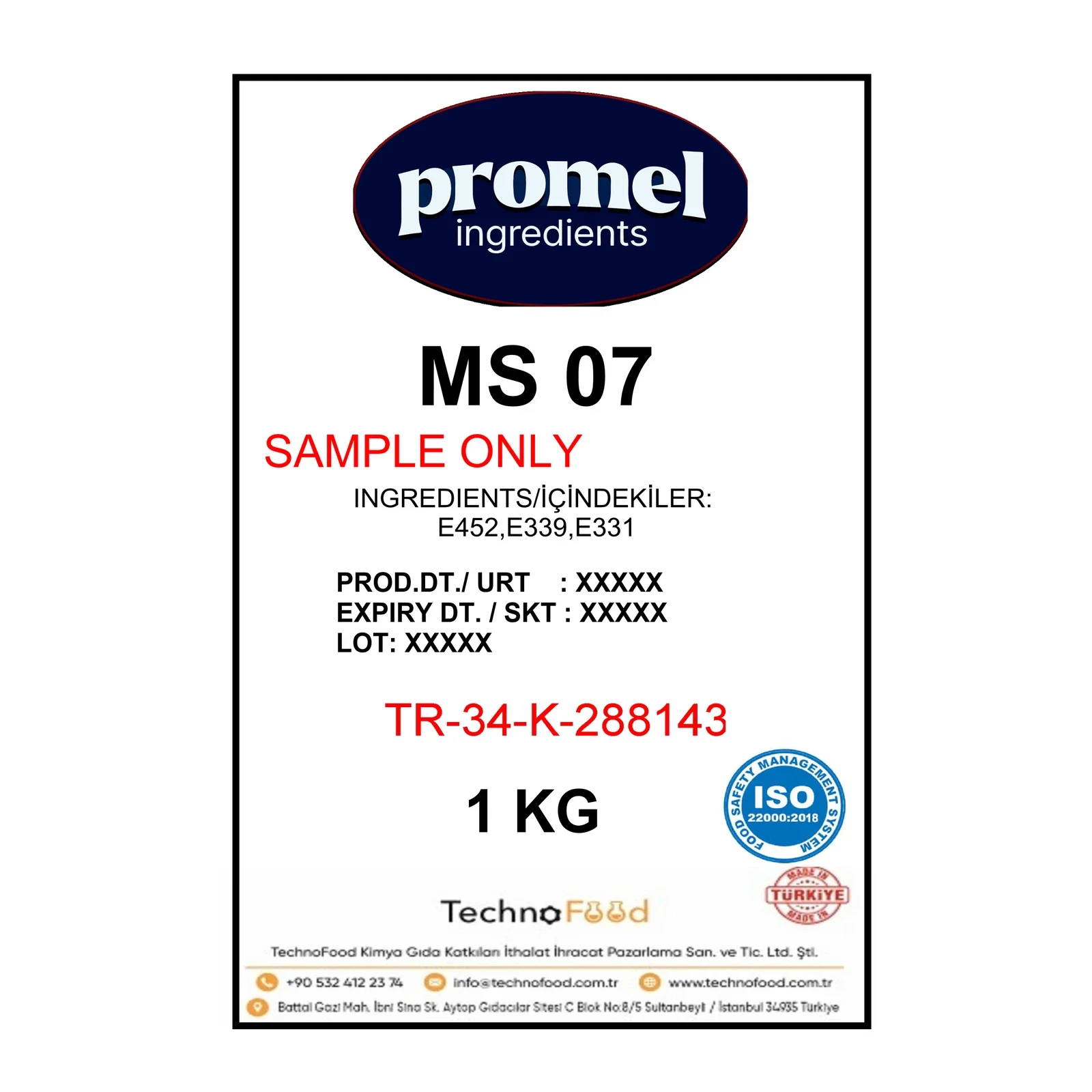
PROMEL MS 07
Promel MS 07 is a single-phase citrate–phosphate emulsifying salt developed for processed pizza cheese and processed cheeses requiring re-meltability. It delivers uniform melting in the oven and clean slicing.
Product description
Promel MS 07 is a ready-to-use emulsifying salt blend containing sodium citrate (E331), polyphosphate (E452) and sodium phosphate (E339). It is balanced for single-component use, eliminating the need to add any other salts to the formulation; hence it is positioned as a "single-phase" emulsifying salt. Its primary application is processed pizza cheese: the goal is a structure that re-melts at oven or toasting temperatures and spreads evenly without running, yet slices cleanly when cold.
The product is also recommended for manufacturers producing frozen pizza cheese and those looking to make processed cheese from Gouda- or Edam-type cheese blends without waiting for extended ripening.
Technical function and working principle
Pizza cheese demands two opposing properties at the same time: a firm, sliceable body when cold and flow (meltability) when heated. Achieving this balance depends on controlling how far the casein is dispersed and how much it re-aggregates (creaming).
- Citrate component forms soluble complexes with calcium, keeping casein in a "loose" network that promotes re-melting and flow. In the literature, the highest meltability is generally observed in citrate-based systems.
- Polyphosphate component sequesters calcium strongly and disperses casein effectively, enabling a stable emulsion even in raw materials with a high proportion of young, intact casein.
- Orthophosphate component buffers the pH and helps keep the blend within the target pH range.
According to the specification, the ion exchange capacity is "strong" while the creaming effect is "weak". Weak creaming prevents the mass from over-thickening and becoming rubbery during cooking — the very basis for the product's ability to re-melt on a second heating. Strong ion exchange, in turn, makes it possible to build a smooth emulsion even from unripened raw materials.
Application areas
- Hard and semi-hard processed cheeses: processed pizza cheese, sliceable and shreddable pizza cheese, frozen pizza applications
- Processed cheeses made from Gouda, Edam and similar cheeses without waiting for ripening
- Spreadable cheeses and cheese sauces: formulations where meltability and flow are the priority (formulation-dependent)
- Plant-based cheese alternatives: meltable pizza-type products
- Fermented milk product-based blends (formulation-dependent)
Key benefits
- Uniform melting and even surface spread in the oven
- Clean sliceability and shape retention when cold
- Convenience of a single-product system: weighing and stock management are simplified
- Ability to work with young raw materials; reduced ripening time and storage costs
- Soft, creamy mouthfeel
Usage and dosage
In the industry, emulsifying salts are typically used at 0.8–1.2 % of the blend; pilot trials with Promel MS 07 can start within this range. Because the product is hygroscopic, it should be used immediately after weighing and distributed homogeneously into the comminuted raw material before cooking. In pizza cheese, excessive mixing and prolonged cooking times can increase creaming and reduce meltability; therefore mixing speed and the temperature–time profile are just as important as dosage.
With a P₂O₅ content of approximately 25 %, a 3 % usage rate delivers roughly 7.5 g/kg P₂O₅ to the blend — comfortably below the regulatory phosphate upper limit for processed cheese. Optimum dosage should be determined by pilot trials based on the specific raw materials and formulation.
Technical specifications
| Parameter | Value |
|---|---|
| E numbers | E331, E452, E339 |
| Appearance | White, hygroscopic powder |
| pH (1 % solution) | 7.0–8.0 (per technical data sheet and certificates of analysis) |
| P₂O₅ content | 25 % ± 0.5 |
| Loss on drying | Less than 15 % |
| Ion exchange capacity | Strong |
| Creaming effect | Weak |
| Heavy metals (Cd, Hg, As, Pb) | Max. 1 ppm each |
| Fluoride | Max. 10 ppm |
Packaging and storage
PE liner inside 25 kg plastic bags, palletised on 100 × 120 cm pallets (1 tonne per pallet). Store in a cool, dry, odour-free environment; once opened, reseal the bag tightly due to the product's hygroscopic nature. Shelf life is 2 years.
Frequently asked questions
What does "single-phase" mean?
The citrate, polyphosphate and orthophosphate components in Promel MS 07 are balanced within a single blend. There is no need for the user to weigh and proportion separate salts; the entire emulsification process is carried out with one product.
What is the difference between Promel MS 07 and PROMEL MS 31?
Promel MS 07 contains citrate and prioritises re-melting; it is designed for pizza cheese. PROMEL MS 31 is citrate-free and targets high water binding and a firm block structure; sliceability and stability take precedence over meltability.
Why is it preferred for frozen pizza cheese?
After freeze–thaw cycles the structure must be preserved, yet the product must still re-melt during baking. The weak creaming effect combined with the flow provided by citrate contributes to uniform melting during this second heating.
What happens if the dosage is exceeded?
Excessive emulsifying salt levels can cause salty and slightly bitter off-notes, an overly soft body and oiling-off during cooking. Dosage should therefore be optimised incrementally at pilot scale.
To achieve the ideal meltability–sliceability balance in your pizza cheese formulation, contact our technical team and request a Promel MS 07 sample.
Applications
HARD AND SEMI-HARD CHEESES · SPREADABLE CHEESES · SAUCES · VEGAN CHEESES · FERMENTED DAIRY PRODUCTS