

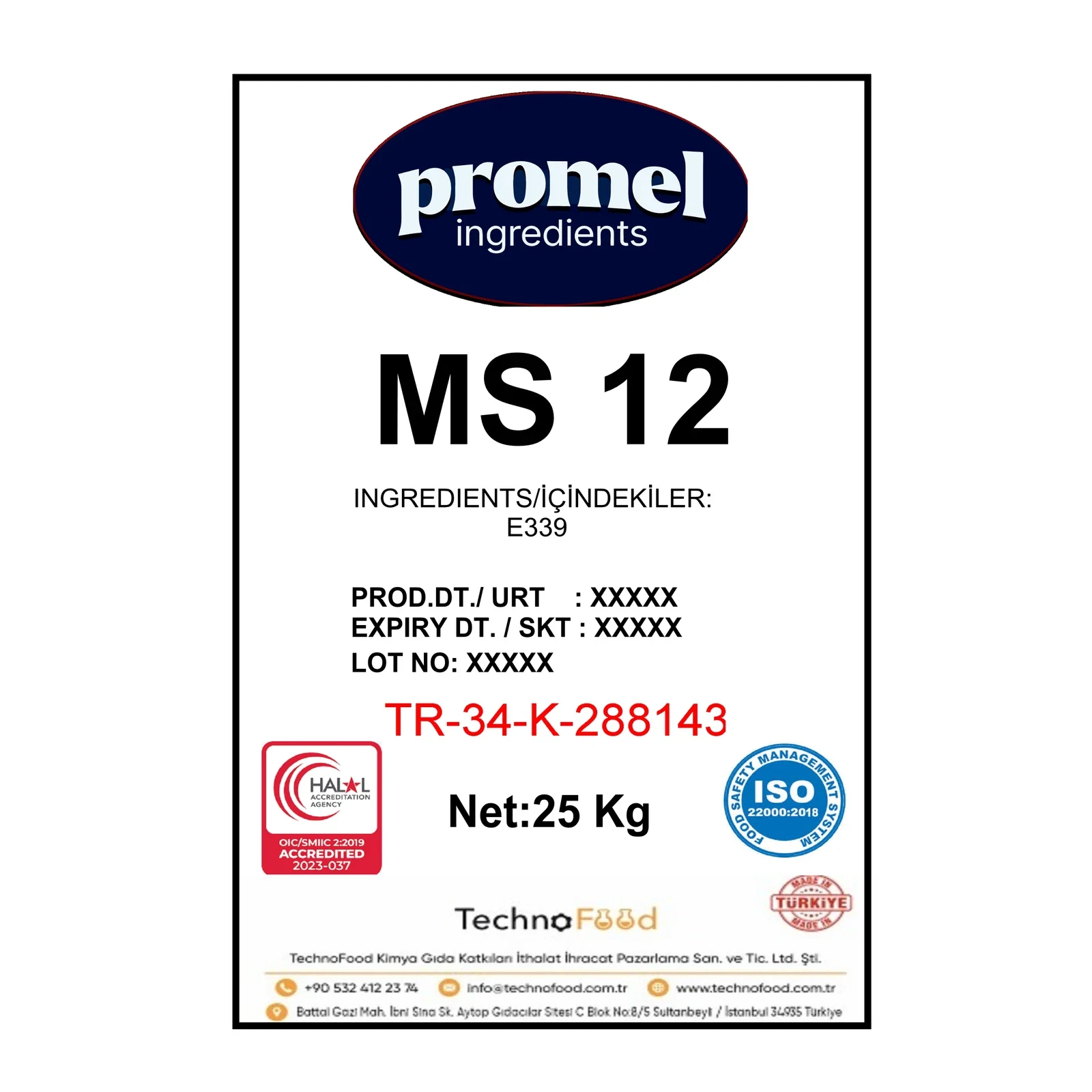
PROMEL MS 12
Promel MS 12 is an alkaline phosphate salt that raises pH in a controlled manner in processed cheese and dairy-based products. It is used as a corrective agent alongside the primary emulsifying salt when working with high-acidity raw materials.
Product description
Promel MS 12 is an alkaline emulsifying salt based on sodium orthophosphate (E339), with a pH of approximately 12 in a 1% solution. Unlike the other products in the range, it is designed not to disperse casein but to correct pH: its ion exchange capacity and creaming effect are low, whereas its buffering and alkalising power is high.
One of the most common challenges in processed cheese production is receiving raw material cheese that is more acidic than expected. When over-ripened, high-acidity curd or acidic rework material is used, the pH of the blend falls below target and the primary emulsifying salt alone cannot compensate. In such cases, a small addition of Promel MS 12 to the formulation brings the pH back into the target range.
Technical function and working principle
The effect of emulsifying salts on casein depends largely on the pH of the medium. Phosphate and citrate anions can sequester calcium from calcium paracaseinate and replace it with sodium — converting the protein into soluble sodium paracaseinate — only when they are sufficiently dissociated (ionised). As the pH drops, this ion exchange weakens and the casein approaches its isoelectric point (pH 4.6), leading to a tight, grainy structure; the result is a dry, crumbly texture, a weak emulsion and a risk of oiling-off.
The literature gives typical pH ranges for processed cheeses as 5.8–6.0 for sliced cheese products and 5.5–6.0 for spreadable products; below pH 5.2, emulsification deteriorates noticeably. The alkaline orthophosphate structure of Promel MS 12 brings the pH of the blend back into this range and adds buffering capacity that helps maintain pH equilibrium throughout the product's shelf life. According to the product specification, an addition of approximately 0.1% to the blend raises the pH by roughly 0.1 units, allowing the operator to make corrections in calculable increments.
Applications
- Hard and semi-hard processed cheeses: pH correction in block and sliced cheese formulations using acidic raw materials
- Spreadable cheeses: achieving the target pH and maintaining pH balance throughout shelf life
- Cheese sauces: adjusting sauce pH and preserving flow properties
- Plant-based cheese alternatives: pH adjustment in vegetable protein systems (formulation-dependent)
- Milk stabiliser systems, ice cream and milk-shake mixes, and dairy desserts: as a buffering salt (to be evaluated in the context of the overall system)
Benefits
- Ability to use low-pH raw materials without removing them from the formulation
- Reduced risk of grainy, floury or crumbly texture
- Full expression of the primary emulsifying salt's ion exchange effect at the target pH
- Predictable pH increase with small doses; consistency within and between batches
- A neutral corrective ingredient that does not alter the creaming behaviour of the primary salt
Usage and dosage
Promel MS 12 is not used as a stand-alone emulsifying salt but as a corrective alongside the primary emulsifying salt (e.g. Promel MS 31, MS 07 or MS 91). The required amount is determined by the difference between the measured pH of the raw material blend and the target pH; it is typically in the order of a few tenths of a percent of the total blend. The practical approach is as follows:
- Take a sample of the comminuted raw material blend and measure its pH.
- Calculate the difference from the target pH; use the "0.1% addition ≈ 0.1 pH unit" relationship from the specification as a starting point.
- Add Promel MS 12 together with the primary emulsifying salt to the blend before cooking starts — either dry or dissolved in part of the process water.
- Measure the pH of the finished product to verify the correction; if the target has been exceeded, reduce the dose in the next batch.
Overdosing raises the pH excessively, which can manifest as a soapy taste, excessive softening and stickiness in sliced cheese products. The optimum dosage should be determined by pilot trials based on the specific raw materials and formulation.
Technical specifications
| Parameter | Value |
|---|---|
| E number | E339 (sodium phosphates) |
| Appearance | White powder |
| pH (1% solution) | 12 ± 0.5 |
| P₂O₅ content | 42% ± 0.5 |
| Ion exchange capacity | Low |
| Creaming effect | Low |
| Heavy metals (Cd, Hg, As, Pb) | Max. 1 ppm each |
| Fluoride | Max. 10 ppm |
Packaging and storage
Supplied in 25 kg plastic bags with a PE inner liner. The product is a hygroscopic powder; it should be stored sealed in a cool, dry environment free from foreign odours. Shelf life under appropriate conditions is 2 years.
Frequently asked questions
Can Promel MS 12 be used as a stand-alone emulsifying salt?
This is not recommended. Because its ion exchange and creaming effects are low, it cannot adequately disperse casein on its own. Its role is to establish the pH environment in which the primary emulsifying salt can perform effectively.
Should it be added even when the raw material pH is normal?
No. If the pH of the blend is already within the target range, no corrective is needed. Where the pH varies with season, degree of ripening or rework ratio, Promel MS 12 can be used only in those batches where it is required.
What should be used when the pH needs to be lowered?
In that case, an acidic emulsifying salt or an appropriate acidity regulator for the formulation should be considered. The right choice can be made in consultation with our technical team, based on the raw materials and target end product.
How does the product affect the P₂O₅ limit?
With a P₂O₅ content of approximately 42%, every 1 g/kg of Promel MS 12 used adds roughly 0.4 g/kg P₂O₅ to the blend. This amount must be included in the legal upper-limit calculation together with the phosphate contributed by the primary emulsifying salt.
If your raw material pH is fluctuating, please contact our technical team with your measurement data. We provide samples and pilot trial support to help optimise the combined use of Promel MS 12 and the primary emulsifying salt.
Applications
HARD AND SEMI-HARD CHEESES · SPREADABLE CHEESES · ICE CREAM and MILK SHAKE · SAUCES · VEGAN CHEESES · MILK STABILIZERS · DAIRY DESSERTS