
PROMEL MS 31
Promel MS 31 is a citrate-free polyphosphate blend with high ion-exchange capacity, developed for block and sliced processed cheeses. It delivers strong water binding and stable texture throughout shelf life.
Product description
Promel MS 31 is a citrate-free emulsifying salt blend containing polyphosphate (E452), triphosphate (E451) and sodium phosphate (E339). It is designed for block-type processed cheese, toast cheese and sliceable pizza cheese products. It is one of the highest-phosphate-density products in the range and is rated in the "high" ion-exchange capacity class.
The primary objective of the product is to build a strong casein network and retain water tightly within that network. This yields a firm block that remains sliceable, shows no syneresis and does not soften throughout its shelf life—even in high-moisture formulations.
Technical function and working principle
The casein in cheese exists as calcium paracaseinate cross-linked by calcium bridges; in this form it is insoluble in water and cannot emulsify fat. Emulsifying salts sequester calcium and replace it with sodium (ion exchange), converting the protein into soluble sodium paracaseinate. The liberated casein hydrates, coats fat droplet surfaces and binds water.
Phosphate chain length determines the strength of this effect. Scientific studies rank calcium sequestration capacity as follows: long-chain polyphosphates > triphosphate > diphosphate > citrate > orthophosphate; in general, the longer the chain, the firmer the resulting processed cheese. The polyphosphate and triphosphate components in Promel MS 31 deliver strong calcium sequestration and casein dispersing power, while the alkaline character (pH ≈ 11.5) helps shift the mix pH into the optimal zone for sliced products. Long-chain phosphates partially hydrolyse during cooking and storage into shorter chains; this plays a role in the structural maturation of the product throughout its shelf life.
The absence of citrate in the formula is a deliberate choice. Citrate promotes high meltability (flow) but can loosen the structure in block products. The citrate-free system is designed to minimise slice-to-slice adhesion and end-of-shelf-life softening.
Applications
- Firm and semi-firm processed cheeses: block-type processed cheese, toast cheese, sliceable pizza cheese
- Block products manufactured continuously in twin-screw cookers
- Plant-based cheese alternatives: as a structure-building salt in vegetable fat–protein systems (formulation-dependent)
Benefits
- High water-binding capacity, allowing a higher moisture level in the formulation
- Firm block texture that is sliceable and shreddable
- Reduced risk of syneresis and oiling-off
- Citrate-free formula reduces slice adhesion and softening tendency during shelf life
- Compatible with twin-screw cooking systems
Usage and dosage
Emulsifying salts are typically used at 0.5–1 % of the total mix in the industry; this range is also the starting point for Promel MS 31. The product is added to the shredded cheese blend before cooking begins, either dry or dissolved in part of the formulation water. The dosage is determined by the degree of ripening of the raw material (proportion of intact casein), the fat/dry matter balance and the target firmness: young raw material contains more intact casein and therefore requires stronger ion exchange.
Note for phosphate load calculation: with approximately 50 % P2O5 content, Promel MS 31 contributes about 15 g/kg P2O5 to the mix when used at 3 %. Since the total legal limit for phosphates in processed cheese is 20 g/kg expressed as P2O5, any corrective phosphates added must also be included in the calculation. The target pH for sliced products is generally in the 5.8–6.0 range; if the raw material is too acidic, adjustment can be made with Promel MS 12. The optimum dosage should be determined through pilot trials based on the raw material and formulation.
Technical specifications
| Parameter | Value |
|---|---|
| E numbers | E452, E451, E339 |
| Appearance | White powder, free from foreign odour and taste |
| pH (1 % solution) | 11.5 ± 0.5 |
| P2O5 content | 50 % ± 0.5 |
| Loss on drying | Less than 15 % |
| Ion-exchange capacity | High |
| Creaming effect | Low |
| Heavy metals (Cd, Hg, As, Pb) | Max. 1 ppm each |
| Fluoride | Max. 10 ppm |
Packaging and storage
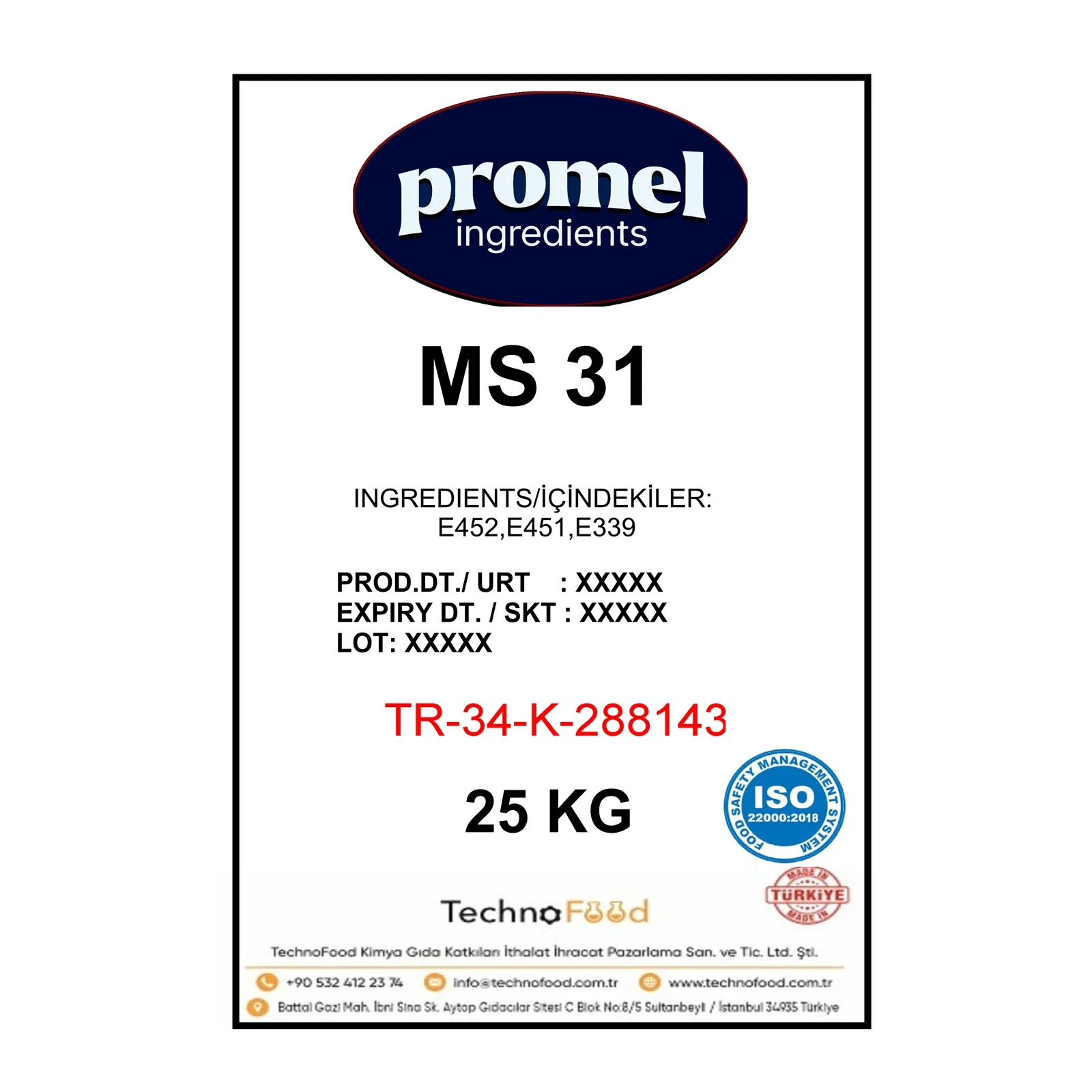
Supplied in 25 kg plastic bags with inner PE liner, palletised in 1-tonne lots. Store in a clean, dry area at room temperature, away from odorous materials. Shelf life: 2 years.
Frequently asked questions
What is the difference between Promel MS 31 and Promel MS 85?
Promel MS 31 is a citrate-free polyphosphate blend with high ion-exchange capacity, targeting a firm block and strong water binding. Promel MS 85 is a citrate–phosphate blend with moderate ion-exchange capacity that emphasises re-meltability (flow on pizza).
What happens if the dosage is too high?
Excess polyphosphate can make the product excessively firm and rubbery, raise the pH due to its alkaline character—leaving a soapy off-note—and bring the P2O5 level close to the legal limit.
Can it be used in kashar cheese?
No. The Turkish Food Codex Cheese Communiqué does not permit the use of emulsifying salts in kashar cheese. Promel MS 31 is intended for processed cheese and processed-cheese-based products.
Is it used alone or in combination?
In many block formulations it is sufficient on its own. Where greater meltability is desired or the raw-material pH is not suitable, a combination with another Promel emulsifying salt can be considered.
Share your raw-material profile and target product specifications with us, and our technical team will provide samples and application support for formulation optimisation and pilot trials with Promel MS 31.