
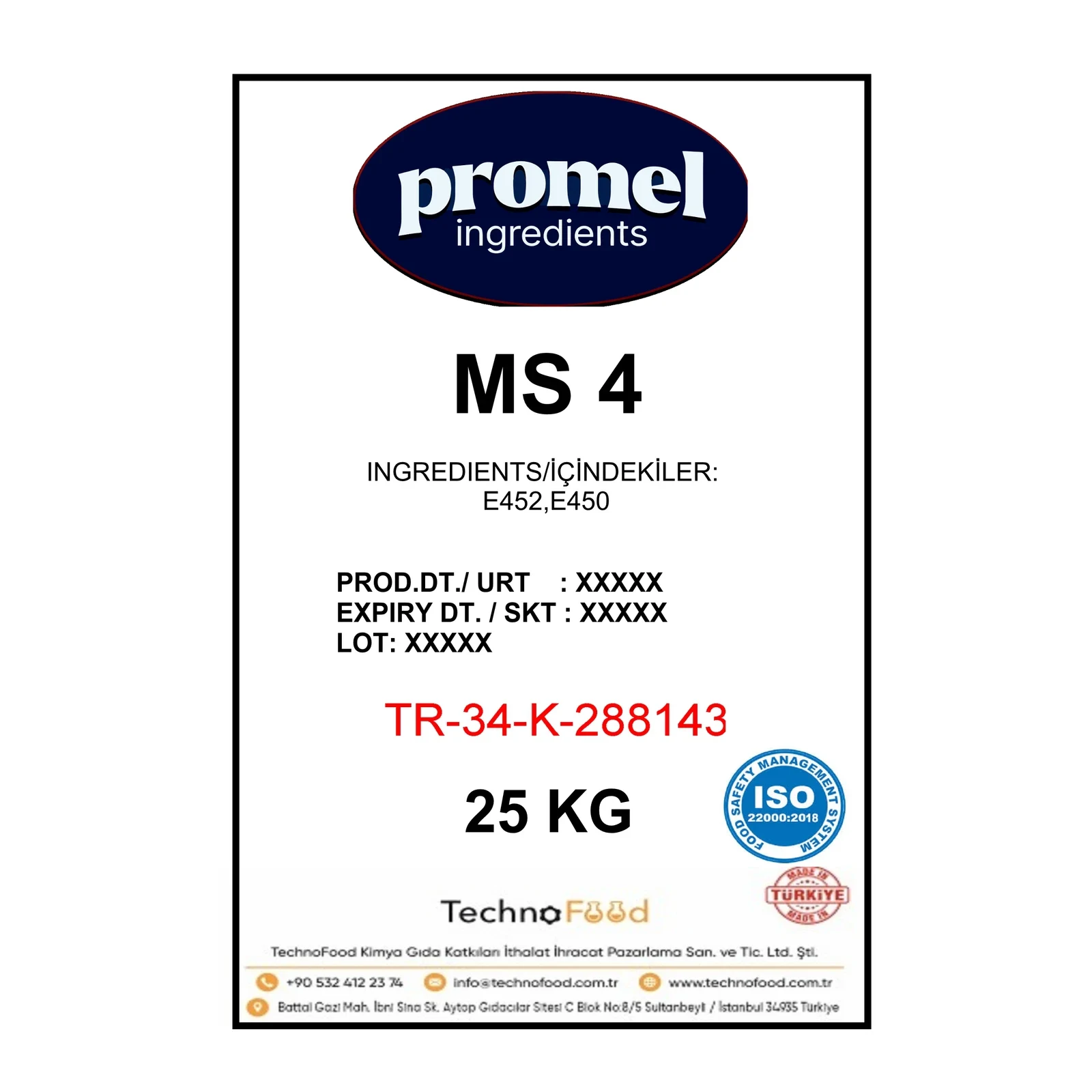
Promel MS 4
Promel MS 4 is a citrate-free emulsifying salt based on diphosphate (E450) and polyphosphate (E452) that delivers a glossy, homogeneous texture in soft-type and spreadable processed cheeses.
Product description
Promel MS 4 is a citrate-free emulsifying salt blend composed of diphosphate (E450) and polyphosphate (E452). It has been developed for soft-type processed cheeses and delivers a distinctive gloss in the finished product. The pH of a 1% solution is approximately 8.0.
The citrate-free formula is preferred in formulations where citrate-specific flavour notes are undesirable and where the texture must remain more stable throughout shelf life. Promel MS 4 can serve as the primary emulsifying salt across a broad range of applications, from spreadable products to soft-textured blocks and sauces.
Technical function and working principle
Diphosphate and polyphosphate are the two most effective classes of emulsifying salts, yet they fulfil different roles. Polyphosphate is a powerful calcium-sequestering agent: it rapidly disperses casein by exchanging the calcium in calcium paracaseinate with sodium, thereby stabilising the emulsion. Diphosphate, while providing moderate calcium sequestration, markedly promotes creaming; it accelerates the restructuring of protein with fat and water during cooking, building viscosity and a creamy texture.
Using both components together ensures that soft-textured products achieve both a stable emulsion and a fine, homogeneous, glossy structure. The moderately alkaline pH (≈8.0) helps shift the batch pH into the optimum zone for spreadable and soft products while limiting the off-flavours associated with excessive alkalinity.
Applications
- Spreadable cheeses: cup, tube and portion-type soft processed cheeses
- Hard and semi-hard processed cheeses: soft-textured block and sliceable products
- Sauces: rich and glossy cheese sauces
- Plant-based cheese alternatives: spreadable plant-based products (formulation-dependent)
Key benefits
- Distinctive gloss and smooth appearance in the finished product
- Clean flavour and stable texture throughout shelf life thanks to the citrate-free formula
- Homogeneous, creamy texture through enhanced creaming
- Stable emulsion resistant to oiling-off and syneresis
- Adjustable texture to different softness levels via dosage and process parameters
Usage and dosage
The typical usage rate for emulsifying salts is 2–3% based on the cheese blend. Promel MS 4 is added to the comminuted raw material before cooking. Because the diphosphate component promotes creaming, cooking time and stirring speed should be adjusted together with the dosage to reach the desired consistency; excessively long cooking can make the product overly thick. The total phosphate load must be evaluated together with any other phosphates in the formulation to remain within the legal upper limit. Optimum dosage should be determined by pilot trials according to the raw materials and formulation.
Technical specifications
| Parameter | Value |
|---|---|
| E numbers | E452, E450 |
| Appearance | White powder, free from foreign odour and taste |
| pH (1% solution) | 8.0 ± 0.5 |
| Loss on drying | Less than 15% |
| Total aerobic count | <100 cfu/g (as analysed) |
| Moulds and yeasts | <10 cfu/g (as analysed) |
| E. coli | <10 cfu/g (as analysed) |
| Heavy metals (Cd, Hg, As, Pb) | Max. 1 ppm each |
| Fluoride | Max. 10 ppm |
Packaging and storage
As it is a hygroscopic powder, store in a dry, cool and well-ventilated area with the packaging sealed. Shelf life is 2 years from the date of manufacture as stated on the certificate of analysis.
Frequently asked questions
What is the difference between Promel MS 4 and Promel MS 91?
Both are designed for spreadable products. Promel MS 4 is citrate-free and consists solely of chain phosphates (diphosphate, polyphosphate), whereas Promel MS 91 is a four-component, more alkaline system that also contains orthophosphate and citrate. Promel MS 4 is the preferred choice when citrate notes are undesirable in the flavour profile.
Why does the absence of citrate matter?
Citrate enhances meltability and softness; however, in certain formulations it can cause excessive softening over shelf life or impart a slightly sour note. The citrate-free system is designed for products where these effects are undesirable.
What if my product is not glossy enough?
Gloss depends on emulsion fineness, pH and fat content. Cooking temperature, time and homogenisation conditions should be reviewed alongside the salt dosage.
To achieve your gloss and consistency targets in soft and spreadable processed cheese formulations, request a Promel MS 4 sample and technical support.
Applications
HARD AND SEMI-HARD CHEESES · SPREADABLE CHEESES · SAUCES · VEGAN CHEESES