

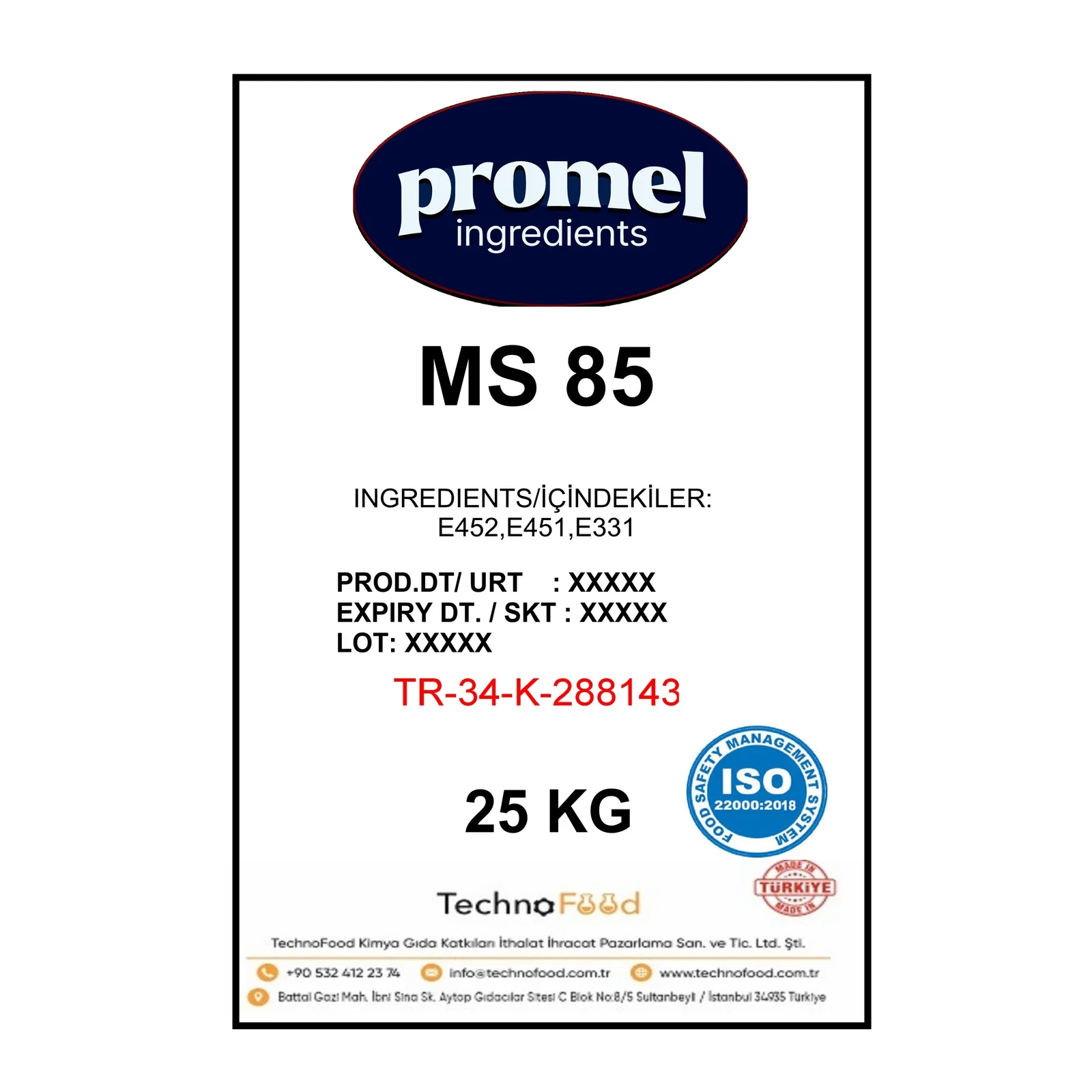
PROMEL MS 85
Promel MS 85 is a citrate–phosphate-based, medium-strength emulsifying salt blend designed for analogue mozzarella, pizza cheese and hard/semi-hard processed cheeses where remeltability is critical.
Product description
Promel MS 85 is a balanced emulsifying salt blend of citrate (E331) and phosphate salts (polyphosphate, triphosphate and/or diphosphate). Its primary function, as stated on the technical data sheet, is to "improve re-melt properties": it is specifically designed to promote flow and stretch behaviour in products that are reheated at the point of consumption, such as analogue mozzarella and pizza cheese.
Within the product range, Promel MS 85 can be positioned between Promel MS 31 and Promel MS 07: its ion-exchange capacity is "moderate", its creaming effect is "weak", and its P2O5 content places it among the lower-phosphate products in the series. This makes it easier to keep the overall phosphate load under control, particularly in analogue formulations that rely on non-cheese protein and fat sources.
Technical function and working principle
In a processed cheese designed to re-melt, the casein network must not be built "too tightly". Very strong calcium-sequestering agents fully dissociate the casein; the subsequent creaming (re-organisation of the protein into a dense gel) then yields a firm, rubbery product that will not flow in the oven. A moderate-strength ion exchanger, by contrast, opens up the casein just enough to form an emulsion while leaving a loose network.
In Promel MS 85, citrate supports meltability and flow by forming soluble complexes with calcium, while the phosphate components stabilise the emulsion and buffer the pH. The pH of a 1 % solution is approximately 8.5 – a moderate alkalinity well suited to bringing a typical cheese blend into the pH 5.8–6.0 zone targeted for sliced and pizza-type products. The relatively high phosphate-to-citrate ratio is intentional: it limits the excessive softening and premature "ripening" effect that high citrate levels can cause.
Applications
- Analogue (imitation) mozzarella and pizza cheese analogues
- Hard and semi-hard processed cheeses: sliceable/shreddable blocks for pizza and toasted sandwich applications
- Plant-based cheese alternatives: melting and stretching plant-based formulations (formulation-dependent)
Key benefits
- Controlled re-melt in oven and toasted sandwich applications
- Prevention of rubbery texture thanks to a loose casein network
- Low P2O5 load, leaving room in the formulation for additional phosphates or corrective salts
- Phosphate counterbalances the excessive softening effect of citrate
- Stable emulsion with casein/caseinate and vegetable fat in analogue systems
Usage and dosage
In industry practice, emulsifying salts are typically used at 0.5–1 % of the total blend. In analogue formulations the dosage depends on the protein source (rennet casein, cheese, caseinate) and the protein ratio; formulations based predominantly on rennet casein generally require a higher salt level to ensure full hydration of the casein. Promel MS 85 should be dissolved in part of the process water or added with the dry blend before heating begins.
At a 3 % usage rate, the calculated P2O5 contribution is approximately 4.7 g/kg – well below the legal phosphate limit. The optimum dosage should be determined by pilot trials based on the specific raw materials and formulation.
Technical specifications
| Parameter | Value |
|---|---|
| E numbers | E331 and phosphates (E452, E451 / E450, E339 – specified on the certificate of analysis per batch) |
| Appearance | White powder |
| pH (1 % solution) | 8.5 ± 0.5 |
| P2O5 content | 15.5 ± 0.5 % |
| Loss on drying | Less than 15 % |
| Ion-exchange capacity | Moderate |
| Creaming effect | Weak |
| Heavy metals (Cd, Hg, As, Pb) | Max. 1 ppm each |
| Fluoride | Max. 10 ppm |
Packaging and storage
Supplied in 25 kg plastic bags with an inner PE liner. Store in a clean, dry area at room temperature, away from odorous products. Shelf life: 2 years.
Frequently asked questions
Do Promel MS 85 and Promel MS 07 serve the same purpose?
Both are citrate–phosphate blends designed for re-melt applications. Promel MS 07 has a strong ion-exchange capacity and a higher P2O5 content, making it particularly suited to pizza cheese based on natural cheese. Promel MS 85 offers moderate strength and serves as a more flexible starting point for formulations based on non-cheese protein sources, such as analogue mozzarella.
Does the product cause premature ripening?
The phosphate-to-citrate ratio in the formulation is deliberately kept high to limit the softening and flavour changes that can occur at high citrate levels. Since shelf-life behaviour is formulation-dependent, it should be verified through storage trials.
Can it be used in kashar cheese production?
No. Regulations do not permit the use of emulsifying salts in kashar cheese; Promel MS 85 is intended for processed cheese and cheese analogue products.
To fine-tune the melt profile of your analogue or natural-cheese-based pizza formulation, request a Promel MS 85 sample and trial support from our technical team.