

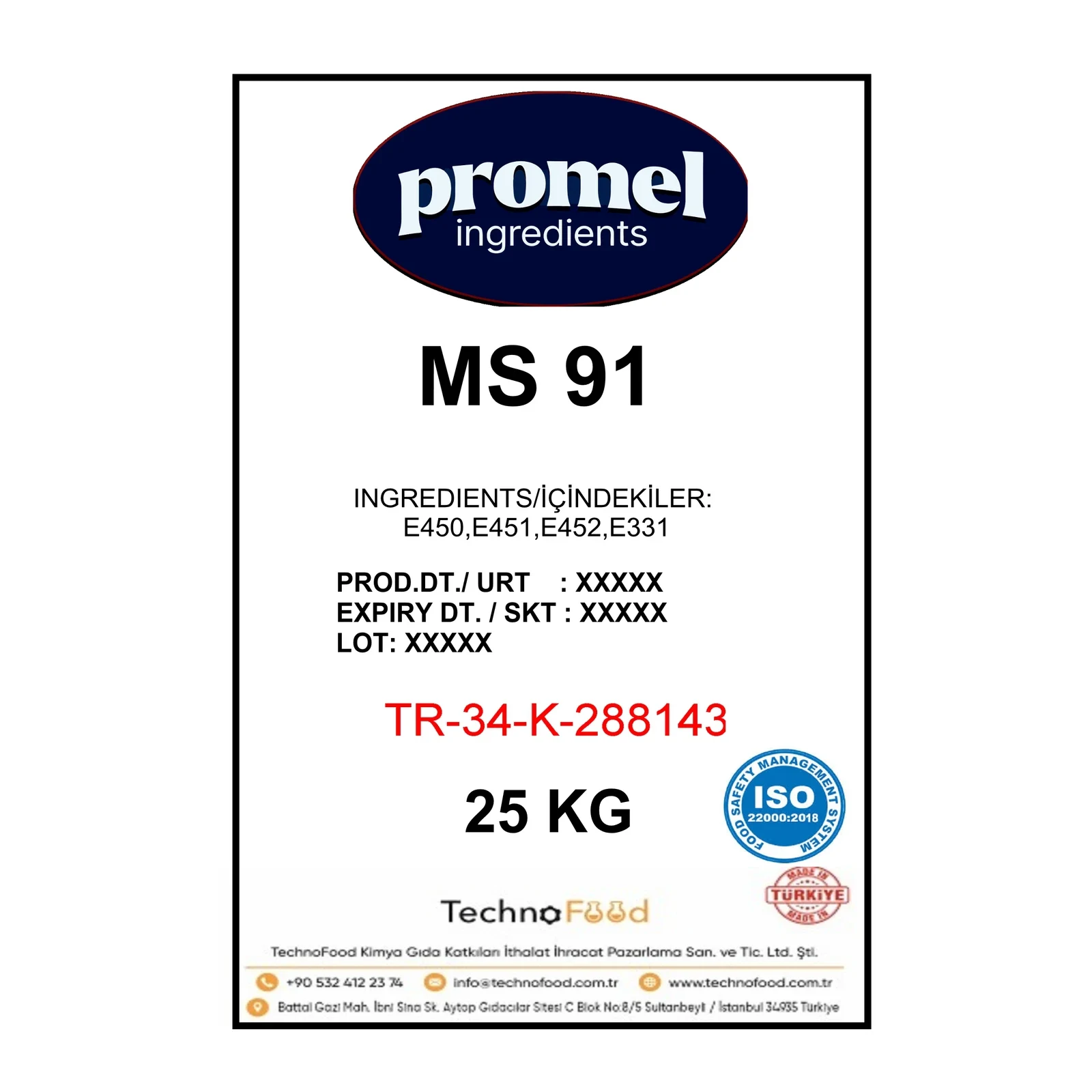
PROMEL MS 91
Promel MS 91 is a phosphate–citrate-based emulsifying salt blend that delivers a glossy, smooth surface and easily spreadable consistency in cream cheese, processed cheese triangles and spreadable processed cheeses.
Product description
Promel MS 91 is an emulsifying salt blend combining sodium phosphate (E339), diphosphate (E450), polyphosphate (E452) and sodium citrate (E331). It is designed for spreadable processed cheeses: cream cheese-type coated products, portioned processed cheese triangles and spreadable cheeses in tubs and tubes are its primary applications. It delivers a glossy, smooth and homogeneous appearance with easy spreadability in the end product.
Its alkaline character (pH approximately 9.1 in 1% solution) facilitates reaching the slightly elevated pH range typically targeted in spreadable products.
Technical function and working principle
Unlike sliceable products, the texture of spreadable processed cheese is the result of a creaming process. After the emulsifying salt sequesters calcium and disperses casein as sodium paracaseinate, the protein re-interacts with fat droplets and water as temperature and agitation continue; viscosity rises and a fine, creamy structure develops. This controlled thickening is steered by the correct salt selection.
- Diphosphate is the phosphate class that most strongly promotes creaming; it contributes to viscosity build-up and the development of a creamy structure.
- Polyphosphate provides calcium sequestration and casein dispersing power, keeping the emulsion stable.
- Orthophosphate buffers pH and helps reach the pH 5.7–6.0 range typical for spreadable products.
- Citrate imparts surface gloss and a smooth, mellow mouthfeel.
The balance of these four components is aimed at achieving both a stable emulsion (no oiling-off or syneresis) and a consistency that is maintained throughout shelf life in spreadable products.
Application areas
- Spreadable cheeses: cream cheese-type processed cheeses, processed cheese triangles (portions), tub and tube cheeses
- Cheese sauces: thick, glossy sauce and dip applications
- Hard and semi-hard processed cheeses: as a secondary salt in soft-textured block formulations
- Spreadable blends based on fermented milk products (formulation-dependent)
Key benefits
- Glossy, smooth and visually appealing surface
- Easily spreadable, homogeneous consistency
- Consistent viscosity through controlled creaming
- Stable emulsion resistant to oiling-off and syneresis
- Suitable flow properties for hot-fill portion and tub packaging
Usage and dosage
Emulsifying salts are typically used in the industry at 1.5–2.5% of the blend. In spreadable products, the dose is adjusted according to the dry matter and fat content, the maturity of the raw material used and the target consistency. Promel MS 91 is added to the raw material before cooking; mixing is then continued at the appropriate temperature until the desired level of creaming is reached.
Creaming depends on both the salt and the process: insufficient mixing yields a thin, runny product, while excessive mixing produces an overly thick, pasty result. Therefore salt dosage and cooking time must be optimised together. The phosphate load must be calculated together with other phosphate sources in the formulation to remain within the legal maximum. Optimum dosage should be determined by pilot trials based on the raw materials and formulation.
Technical specifications
| Parameter | Value |
|---|---|
| E numbers | E339, E450, E452, E331 (as per certificate of analysis) |
| Appearance | White powder, free from foreign odour and taste |
| pH (1% solution) | 9.1 ± 0.5 |
| Loss on drying | Less than 15% |
A detailed technical data sheet (TDS) is available upon request.
Packaging and storage
Store in a dry, cool and odour-free environment in its sealed original packaging. According to the certificates of analysis, the product has a shelf life of 2 years from the date of manufacture.
Frequently asked questions
Can Promel MS 91 be used in sliced cheese?
Its primary purpose is spreadable products. Due to its creaming-promoting character, it may leave the structure too soft when used alone in sliceable products; Promel MS 31 or MS 38 are more suitable starting points for sliceable formulations.
What is the difference between Promel MS 91 and Promel MS 80?
Promel MS 91 contains diphosphate and polyphosphate; it supports creaming and builds a thick, spreadable structure in coated and portioned cheeses. Promel MS 80 is based on citrate and orthophosphate; it excels in cheese sauces where a fluid consistency without thickening is desired.
What should I do if my product turns out too thick?
First check the cooking time and mixing speed; excessive creaming often originates from the process. Then the salt dosage and raw material maturity should be evaluated together.
To achieve your gloss and spreadability targets in your cream cheese or processed cheese triangles formulation, request a Promel MS 91 sample and technical support.
Applications
HARD AND SEMI-HARD CHEESES · SPREADABLE CHEESES · SAUCES · FERMENTED DAIRY PRODUCTS