

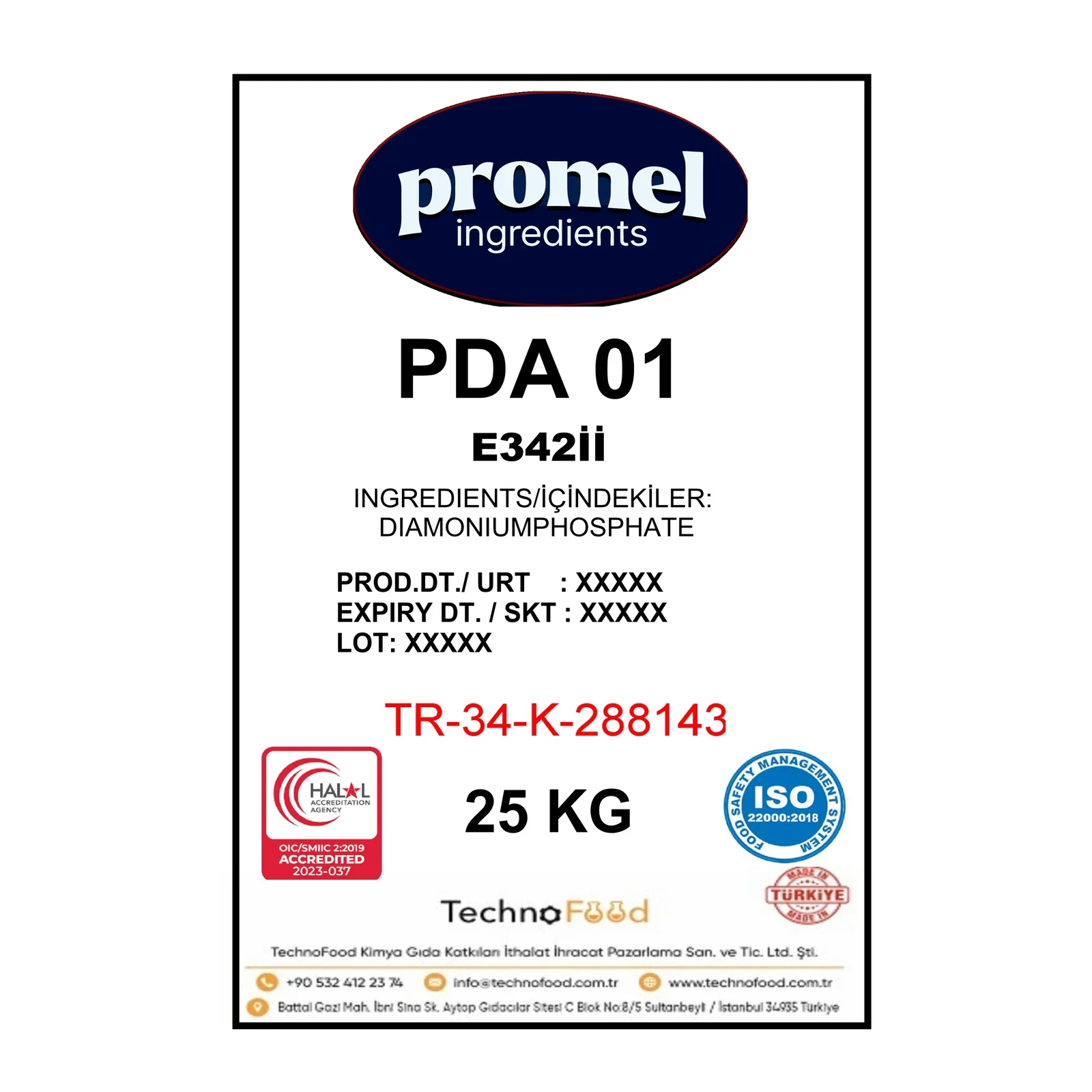
PROMEL PDA 01
Promel PDA 01 is pure diammonium phosphate ((NH4)2HPO4). It serves as a readily available nitrogen and phosphorus source for microorganisms and as a phosphate buffer component in starter culture, yeast and fermentation growth media.
Product description
Promel PDA 01 is pure diammonium phosphate (diammonium hydrogen phosphate, (NH4)2HPO4). It is a white, crystalline, inorganic salt that dissolves readily in water, delivering two essential nutrients simultaneously to growth media used in microorganism production: ammonium nitrogen and phosphate. In the dairy industry, this product is not used in the cheese or fermented milk product itself, but in the environment where the live cultures that make those products are produced and propagated: starter culture, yeast and other fermentation growth media.
The product is not intended as a food additive for incorporation into the final dairy product. Ammonium phosphates (E 342) are not included in the phosphate group (E 338–341, E 343, E 450–452) listed for combined use under the Turkish Food Codex Food Additives Regulation or EU Regulation 1333/2008; they must therefore not be added directly to cheese, yogurt or other dairy products.
Technical function and working principle
Diammonium phosphate performs three distinct roles in a growth medium:
- Nitrogen source: The ammonium ion is used directly by yeasts and many microorganisms for amino acid synthesis. It is one of the principal sources of readily assimilable nitrogen in fermentation yeasts such as Saccharomyces.
- Phosphorus source: Phosphate is essential for ATP, nucleic acids and cell-membrane phospholipids. In intensive cell production, phosphorus deficiency can limit growth.
- pH buffering and calcium sequestration: Phosphate ions slow the pH decline as lactic acid is formed. Their ability to sequester calcium reduces the free calcium required for bacteriophage multiplication in bulk starter growth media; this is the fundamental principle behind phosphate-based phage-inhibitory media.
An important distinction applies to lactic acid bacteria: lactococci and many other lactic acid bacteria are dependent on multiple amino acids (amino acid auxotrophy). These bacteria cannot utilise ammonium as their sole nitrogen source; they require peptides and free amino acids. Consequently, in lactic culture growth media, diammonium phosphate should be regarded not as a substitute for yeast extract, protein hydrolysate or a milk base, but as a complementary nitrogen–phosphorus supplement and buffer component.
An aqueous solution of diammonium phosphate is slightly alkaline, whereas a monoammonium phosphate solution is acidic. This difference allows the two salts to be used individually or in combination when adjusting the initial pH of the growth medium.
Application areas
- Nitrogen–phosphorus supplementation of growth media in starter culture production
- Phosphate buffer and calcium-sequestering component in bulk starter growth media
- Yeast nutrient in yeast propagation and fermentation growth media
- Growth medium formulation in quality-control and R&D laboratories
Benefits
- Supplies both nitrogen and phosphorus from a single ingredient, simplifying the growth medium formulation.
- As a pure, single-component material, its contribution to the formulation is traceable and reproducible.
- Helps reduce the risk of sluggish or stuck fermentation caused by nitrogen deficiency in yeast fermentations.
- The phosphate buffer moderates pH decline during culture production, potentially extending the cell-growth phase.
- Dissolves rapidly in water; easily incorporated into dry medium blends.
Usage and dosage
Diammonium phosphate is dissolved in water along with the other dry ingredients when preparing the growth medium. Typical usage levels in growth medium formulations are in the order of a few grams per litre (approximately 0.5–5 g/L); the exact amount depends on the microorganism, other nitrogen sources and target pH.
- During heat treatment, phosphate may form precipitates with calcium and magnesium ions; dissolving mineral salts separately or adding them to the cooled medium after sterilisation reduces this risk.
- Prolonged heating in the presence of sugars can accelerate browning (Maillard reaction); the sugar component may be sterilised separately.
- Ammonia loss may occur under alkaline conditions and at high temperatures; avoid boiling the medium longer than necessary.
- An amino acid and peptide source must be provided separately in lactic culture growth media.
Optimum dosage should be determined by pilot trials based on the raw materials and formulation. A technical data sheet (TDS) is available on request.
Frequently asked questions
Can Promel PDA 01 be added to cheese or yogurt as a food additive?
No. Ammonium phosphates are not among the phosphates permitted for dairy products under the Turkish Food Codex Food Additives Regulation. The product is intended for growth media used in culture and yeast production. For applications such as processed cheese, emulsifying salts based on phosphates and citrates permitted for the relevant food category should be used.
Is it sufficient as the sole nitrogen source for lactic acid bacteria?
No. Lactococci and many lactic acid bacteria have amino acid requirements that ammonium cannot meet. Diammonium phosphate is used as a complementary component alongside yeast extract, peptone or a milk-based growth medium, providing phosphorus and buffer capacity.
What is the difference between diammonium phosphate and monoammonium phosphate?
Both are ammonium phosphates. Diammonium phosphate carries two ammonium groups per molecule, so its nitrogen content is higher (theoretically approximately 21 %, versus approximately 12 % for monoammonium phosphate), and its solution is slightly alkaline; the monoammonium phosphate solution is acidic. One or both salts are selected depending on the target pH of the growth medium.
Why does turbidity or precipitation occur when sterilising the growth medium?
Phosphate ions form sparingly soluble salts with calcium and magnesium during heat treatment. Sterilising mineral components separately, avoiding prolonged holding of the hot medium and checking the pH after sterilisation help limit precipitation.
To determine the role and dosage of Promel PDA 01 in your culture or yeast growth medium formulation, the Technofood technical team provides formulation evaluation and sample support.