

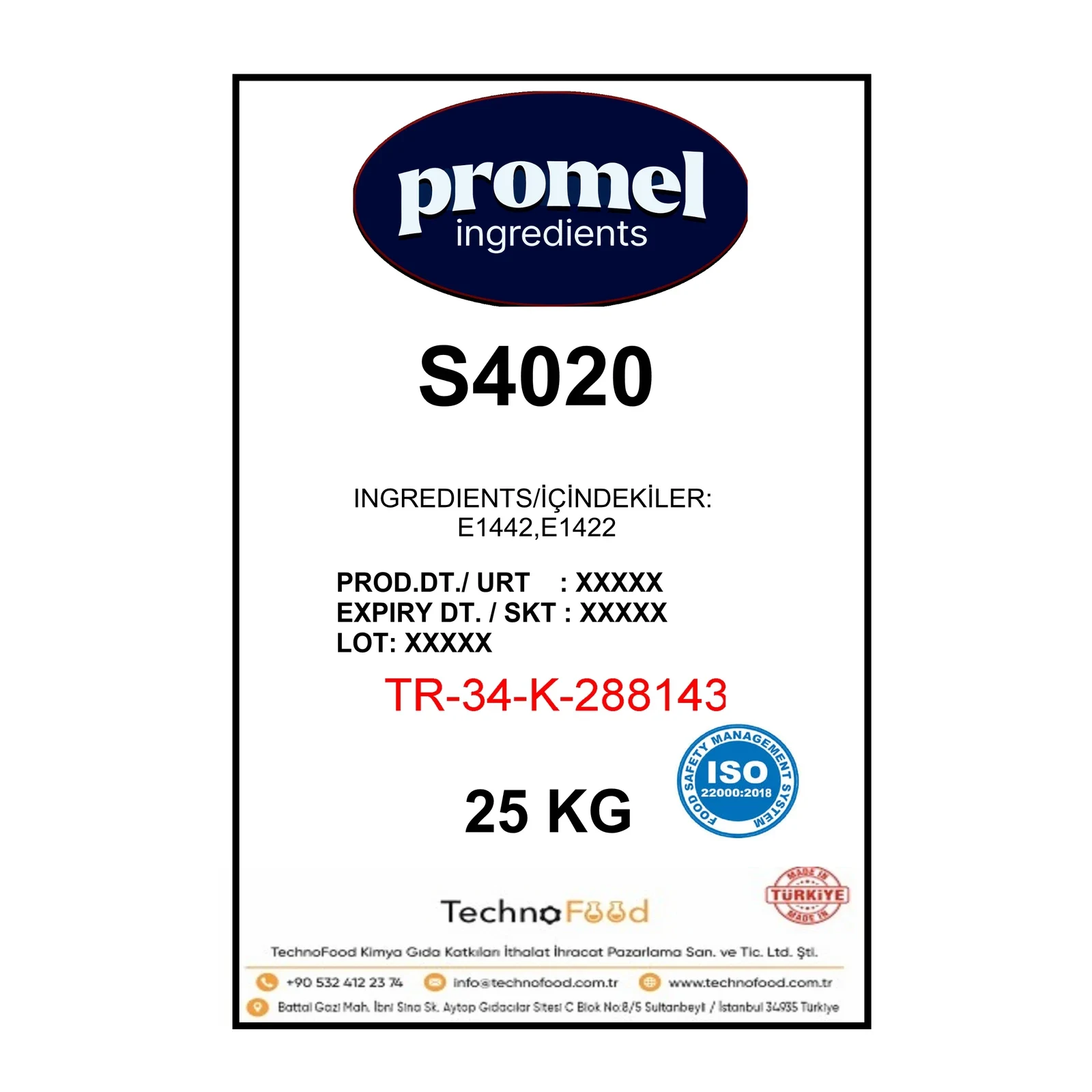
PROMEL S4020 STAB.BLEND
PROMEL S4020 is a modified starch-based stabiliser blend offering high water and fat binding capacity; it provides body, sliceability and melt control in vegetable fat cheeses and plant-based cheese alternatives.
Product description
PROMEL S4020 is a modified starch-based stabiliser blend in powder form. Owing to its high water and fat binding capacity, it is designed particularly for systems with low or no casein content: vegetable fat hard analogue cheeses, plant-based cheese alternatives, cheese sauces and dairy desserts. In these products the structural framework is formed not by protein but by the starch gel; S4020 is the primary component that builds this framework.
The product differs in principle from the hydrocolloid-based blends in the same category (Supermix series): hydrocolloids bind water at per-mille levels and reinforce the existing protein structure, whereas the starch-based system is used at considerably higher levels and forms the body itself in protein-reduced formulations.
Technical function and working principle
Modified starch granules absorb water on heating, swell and gelatinise; on cooling, amylose and amylopectin chains reorganise to form a cuttable gel. Chemical or physical modification limits starch breakdown during cooking, shearing and acid exposure, and reduces the tendency for water release (retrogradation) during cold storage. The fat phase is trapped as fine droplets within the swollen starch granules and gel network, preventing oiling-off and giving the slice a homogeneous, dry cut surface.
The literature has shown that starch type significantly affects texture and meltability in analogue cheeses: some starches increase firmness and sliceability, while pre-gelatinised types yield a softer structure with better meltability. Starch-based stabiliser selection should therefore be guided by the targeted melting profile.
Application areas
- Hard and semi-hard vegetable fat analogue cheeses
- Plant-based cheese alternatives (block, sliced, shredded)
- Cheese sauces and cheese-based fillings
- Dairy desserts such as pudding and milk pudding
Benefits
- High water and fat binding; enables reduction of casein and milk solids in the formulation
- Sliceable, shreddable body that does not crumble on cutting
- Reduced oiling-off and a dry, uniform cut surface
- Limited water release during cold storage
- Process tolerance: structure withstands cooking and shearing
Usage and dosage
Starch-based systems are used at significantly higher levels than hydrocolloid blends; in analogue cheeses the usage level is typically in the range of a few percent, depending on the protein and fat content of the formulation. The product should be pre-blended with the fat phase or other dry ingredients before being fed into the processed cheese cooker; sufficient temperature (typically above 70 °C) and time must be provided for full starch gelatinisation. Insufficient cooking results in a grainy, starchy texture; excessive shearing may cause viscosity loss.
Optimum dosage should be determined by pilot trials based on the raw materials and formulation. Use must comply with the Turkish Food Codex Food Additives Regulation.
Technical specifications
A technical data sheet (TDS) is available on request.
Packaging and storage
PROMEL stabiliser series products are supplied in 25 kg kraft bags. Store in a dry, cool environment with the bag sealed, away from odorous substances. The product is hygroscopic; opened packaging must be protected from moisture.
Frequently asked questions
What is the difference between S4020 and the Supermix series?
Supermix products are hydrocolloid-based (carrageenan and gum) and reinforce the existing protein structure at low dosages. S4020 is starch-based, used at higher dosages, and builds the body itself in protein-reduced or protein-free formulations. In some formulations the two are used together.
What should be done if meltability is insufficient?
As the starch level increases, the structure becomes firmer and meltability decreases. Dosage, fat content and emulsifying salt selection should be adjusted together; if necessary, a combination with a melt-focused hydrocolloid blend may be trialled.
How is it used in dairy desserts?
It is blended cold with milk, sugar and other dry ingredients and then cooked; once the starch has gelatinised, the mixture is filled. A dosage trial is required to achieve the target consistency.
To establish the right starch–hydrocolloid balance in your vegetable fat or plant-based cheese formulation and to request a PROMEL S4020 sample, please contact our technical team.
Applications
HARD AND SEMI-HARD CHEESES · SAUCES · VEGAN CHEESES · DAIRY DESSERTS