

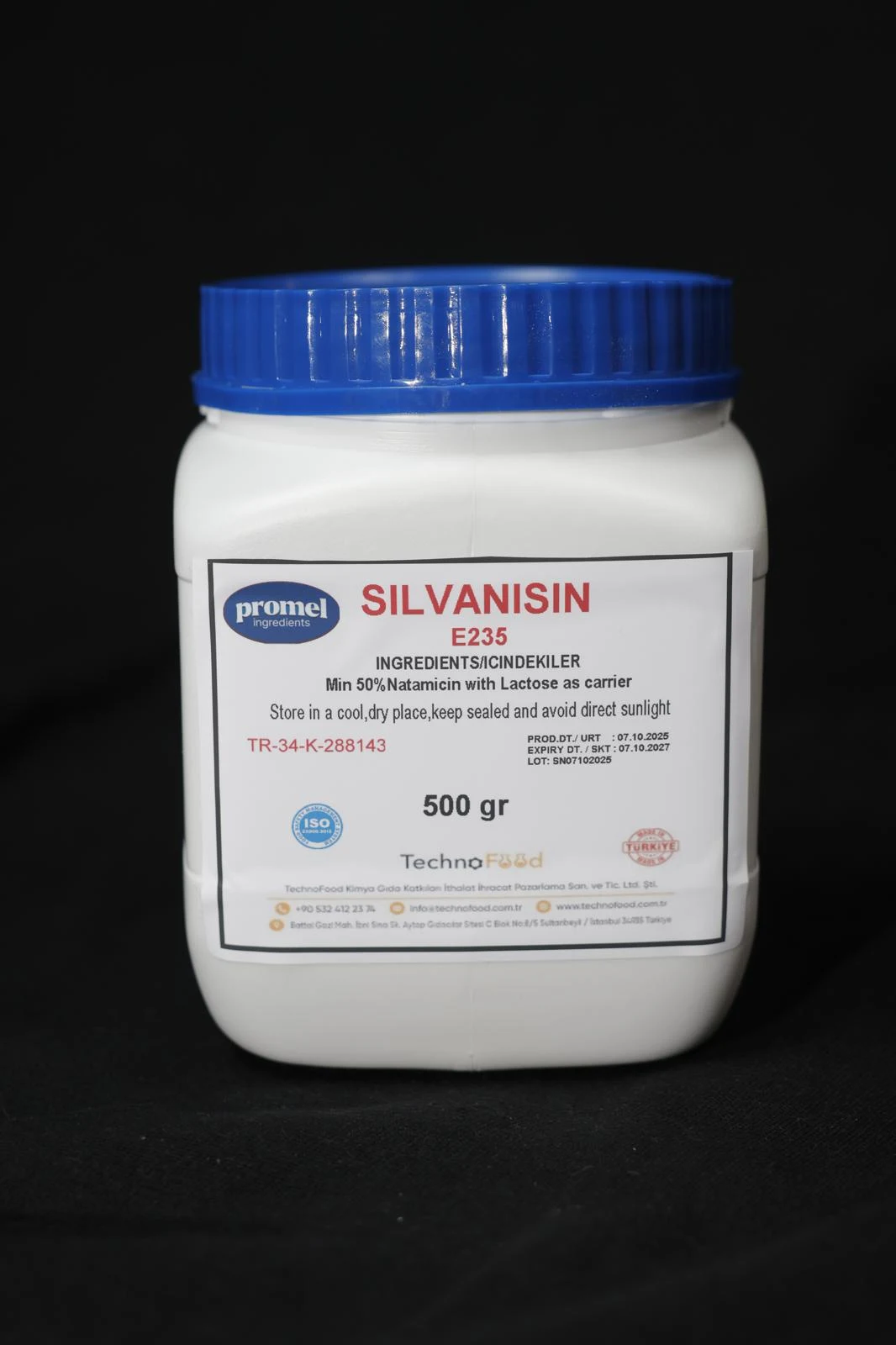
PROMEL SİLVANİSİN
Promel Silvanisin is a nisin (E234)-based preservative produced by Lactococcus lactis fermentation; with an activity of 1000 IU/mg, it is used in processed cheese and cheese to control Clostridium spores and Gram-positive spoilage.
Product description
Nisin is a 34-amino-acid antimicrobial peptide (lantibiotic bacteriocin) naturally produced by fermentation of Lactococcus lactis strains in a milk-based medium. It is designated as food additive E234. Promel Silvanisin is a nisin preparation in the form of a light-brown crystalline powder, standardised with sodium chloride for consistent activity; its potency is 1,000 IU/mg.
The product is used as a preservative in dairy products where heat-surviving spore-forming bacteria and Gram-positive spoilage organisms are a concern — particularly in processed cheese and cheese sauces.
Technical function and mode of action
Nisin binds to lipid II, a key building block of the cell wall in Gram-positive bacteria. This binding has a dual effect: cell-wall synthesis is halted and pores form in the cytoplasmic membrane, causing intracellular ions and ATP to leak out. The result is cell death.
The technological value of nisin largely derives from its activity against spores. Clostridium and Bacillus spores can survive the 80–90 °C heat treatment applied during processed cheese manufacture; nisin inhibits the outgrowth of heat-treated spores after germination. Gas formation, blowing and putrefaction in processed cheese caused by Clostridium tyrobutyricum and Clostridium sporogenes are thereby controlled. Nisin is not effective on its own against Gram-negative bacteria, moulds and yeasts.
Nisin is more stable and more soluble under acidic conditions; at neutral to alkaline pH and during prolonged exposure to high temperatures, activity loss increases.
Applications
- Processed cheese, cheese spreads and cheese sauces
- Hard and semi-hard cheeses for protection against Gram-positive spoilage (where permitted by legislation)
- Unripened (fresh) cheeses (where permitted by legislation)
- Milk-based desserts and pasteurised cream products (subject to national legislation)
Benefits
- Protection against outgrowth of heat-surviving Clostridium and Bacillus spores
- Reduction of blowing, gas formation and off-odours in processed cheese
- Naturally derived antimicrobial produced by fermentation
- Effective at low dosage with no impact on taste or odour
- Easy dosage calculation with standardised activity of 1,000 IU/mg
Usage and dosage
In processed cheese, nisin is typically added to the processed cheese cooker together with the emulsifying salt and other dry ingredients, or dissolved in a small amount of water before addition. Preparing the stock solution in slightly acidic water (e.g. pH 3–4) improves solubility and stability. Because prolonged exposure to high temperatures causes activity loss, processing time and temperature should be carefully considered.
The dosage is calculated based on the target nisin level (mg/kg or IU/g); since pure nisin has an activity of approximately 40 IU/µg, 1 g of a preparation with 1,000 IU/mg activity corresponds to approximately 25 mg of pure nisin. In the literature, typical levels studied in processed cheese range from 5–12.5 mg/kg of pure nisin, corresponding to roughly 0.2–0.5 g/kg of the preparation. The Turkish Food Codex Food Additives Regulation and EU Regulation 1333/2008 define the product categories in which nisin may be used and the maximum permitted levels; the current limits for the relevant product category must be verified before application. The optimum dosage should be determined through pilot trials based on the spore load of the raw material and the formulation.
Technical specifications
| Parameter | Value |
|---|---|
| Appearance | Light-brown, crystalline powder |
| E number | E234 |
| CAS number | 1414-45-5 |
| Activity (nisin potency) | 1,000 IU/mg |
| Loss on drying | Max. 3% |
| pH | 3.10 – 3.60 |
| Sodium chloride | Min. 50% |
| Lead (Pb) | Max. 1 mg/kg |
| Total viable count | Max. 10 CFU/g |
| E. coli and coliforms | < 3.0 MPN/g |
| Salmonella | Absent in 25 g |
Packaging and storage
10 kg carton (20 × 500 g bottles). Store in a cool, dry place with the packaging sealed, protected from direct sunlight. Shelf life: 24 months.
Frequently asked questions
Does nisin affect starter cultures in cheese?
Yes, it can. Lactococci and other Gram-positive lactic acid bacteria may be sensitive to nisin. For this reason, nisin is used primarily in products such as processed cheese, where starter culture activity is not required, rather than in cheese milk undergoing culture-based fermentation.
What is the difference between nisin and lysozyme?
Lysozyme is added to the cheese milk in ripened cheeses to prevent late blowing and has less impact on lactic cultures. Nisin, on the other hand, is more effective at inhibiting spore outgrowth in heat-treated products such as processed cheese.
Does nisin protect against moulds and yeasts?
No. Nisin is effective only against Gram-positive bacteria. Antifungal agents such as natamycin or sorbate are used for mould and yeast control.
Technical support
For dosage calculation, addition-point guidance and regulatory compliance assessment for Silvanisin in your processed cheese or cheese sauce formulation, as well as sample requests, please contact the Technofood technical team.