

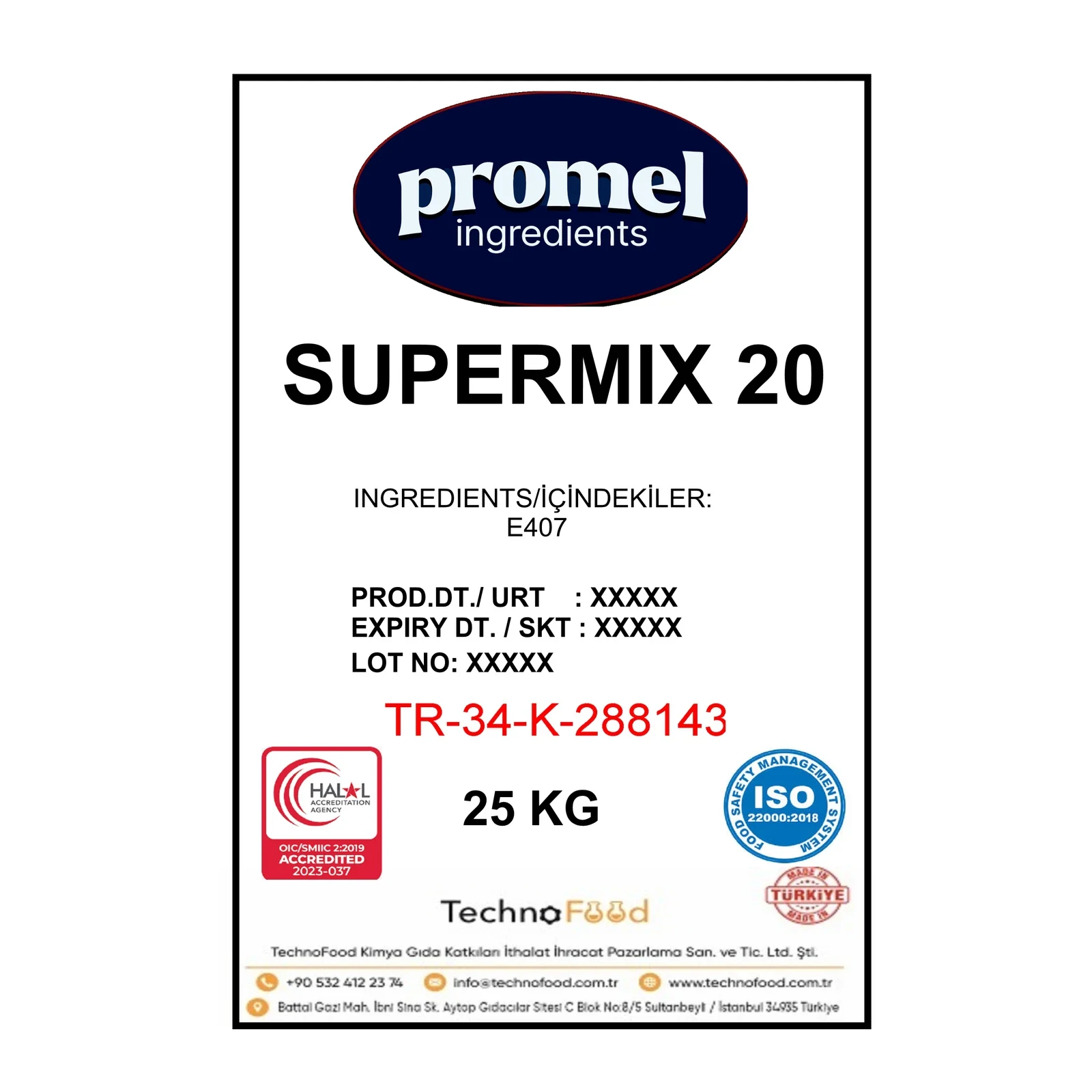
PROMEL Supermix 20
PROMEL Supermix 20 is a hydrocolloid stabiliser system that binds free water in hard and semi-hard block cheeses and cheese analogues, giving a firm, sliceable body with controlled remelting.
Product description
PROMEL Supermix 20 is a powdered stabiliser blend composed of carrageenan (E407), microcrystalline cellulose (MCC, E460) and locust bean gum. It has been developed for mozzarella-type and hard cheese applications. Its primary purpose is to prevent unbound (free) water from remaining in the cheese mass, achieve a firmer body, and improve sliceability as well as remelting behaviour.
The product is used especially in block and sliced cheeses produced by the processed cheese cooker method, in analogue cheeses containing vegetable fat, and in plant-based cheese alternatives. In such formulations, when the casein ratio is reduced or the moisture level is increased the structure weakens, leading to knife sticking during cutting, slice-to-slice adhesion, and moisture release (syneresis) during storage. Supermix 20 fills this gap by forming a strong gel network.
Technical function and working principle
Carrageenan forms the backbone of the blend. It dissolves at high temperatures and gels during cooling by forming helical structures; potassium and calcium ions strengthen the gel. In milk-based systems, the sulphate groups of carrageenan interact electrostatically with the positively charged regions on the surface of casein micelles, thereby linking the protein network to the polysaccharide network and trapping water between the two.
Locust bean gum (galactomannan) does not gel on its own; however, it interacts synergistically with the carrageenan helices, reducing gel brittleness, imparting elasticity, and lowering syneresis. Microcrystalline cellulose, in turn, forms an insoluble, fine particle network that physically retains water, limits structural collapse during heating, and gives the cut surface a smoother, short-breaking texture. The high gel strength specified (above 1000 g/cm² at 1.5 % concentration in water, 20 °C) reflects the firm-body-oriented design of the blend.
Application areas
- Hard and semi-hard block cheeses (kashar and pizza-type blocks produced via the processed cheese cooker method)
- Sliced and shreddable processed cheeses
- Analogue cheeses containing vegetable fat
- Plant-based cheese alternatives (starch and vegetable fat based)
- Mozzarella-type analogue products
Advantages
- Binds free water, reducing moisture release and in-pack leakage during storage
- Firmer body: clean-cut surfaces, less sticking to the blade and between slices
- Controlled remelting in the oven and on toast, less oiling-off
- Compensates for structural loss in formulations with reduced casein levels or increased moisture content
- Powder form; easy dosage as a dry blend with other ingredients
Usage and dosage
The recommended usage rate is 0.6–1 %. In processed cheese and analogue cheese production, the product should be pre-blended with other dry ingredients such as emulsifying salt, salt or milk powder before being added to the cooker to prevent lumping. Adequate temperature (typically above 80 °C) and mixing time must be ensured for full dissolution of the carrageenan and dispersion of MCC; the gel structure forms during cooling. As the dosage approaches the upper limit, the body becomes harder and meltability decreases; at low dosages, water binding may be insufficient.
Optimum dosage should be determined through pilot trials based on the raw materials and formulation; a tailored formulation recommendation can be requested for your specific application. Usage must comply with the permissions and restrictions defined for the relevant food category in the Turkish Food Codex Food Additives Regulation.
Technical specifications
| Parameter | Value |
|---|---|
| Appearance | Powder |
| Colour | White to cream |
| Odour / taste | Free from foreign odour and taste |
| Gel strength (water, 1.5 %, 20 °C) | > 1000 g/cm² |
| Loss on drying | < 12 % |
| Ash | < 0.5 % |
| pH | 7.0–10.0 |
| Total mesophilic count | < 10,000 cfu/g |
| Moulds and yeasts | < 100 cfu/g |
| Coliforms | < 10 cfu/g |
| E. coli / Salmonella | Not detected |
| Arsenic / cadmium / mercury / lead | < 3 / < 2 / < 1 / < 5 ppm |
| GMO status | Non-GMO |
The product does not contain any allergens listed on the allergen register. Since milk, egg, soy and gluten-containing products are also processed on the production line, the risk of cross-contamination should be assessed within the allergen management plan.
Packaging and storage
25 kg kraft bag. Store in a clean, dry area at ambient temperature, away from odorous materials, with the bag sealed. Shelf life is 2 years from the date of manufacture. As the product is a hygroscopic powder blend, opened bags should be consumed promptly and contact with moisture must be avoided.
Frequently asked questions
What is the difference between Supermix 20 and Süpermix 70?
Supermix 20 combines carrageenan with microcrystalline cellulose and locust bean gum; its priority is a firm body, free-water binding and clean slicing. Süpermix 70 combines carrageenan with konjac and locust bean gum, targeting a more elastic, glossy and stretchy structure. For hard and sliceable products it is recommended to start trials with Supermix 20, while Süpermix 70 is suggested for pizza-type products where gloss and stretch are desired.
Can it be added to natural (ripened) cheese milk?
The product is designed for use in processed cheese and analogue cheese masses. Hydrocolloid use in ripened cheeses is restricted by regulation; the food category of your product should be verified before use.
What happens if the dosage is too high?
The structure becomes excessively hard, a jelly-like mouthfeel may develop, and meltability and spread in the oven decrease. For this reason, trials should start at the lower end of the recommended range.
Is a halal certificate available?
The product label bears a halal logo under OIC/SMIIC standards. A current certificate is provided upon request.
For determining the right dosage for your formulation, balancing emulsifying salt and stabiliser levels, and planning a pilot trial, please contact our technical team. You can also request a PROMEL Supermix 20 sample.