

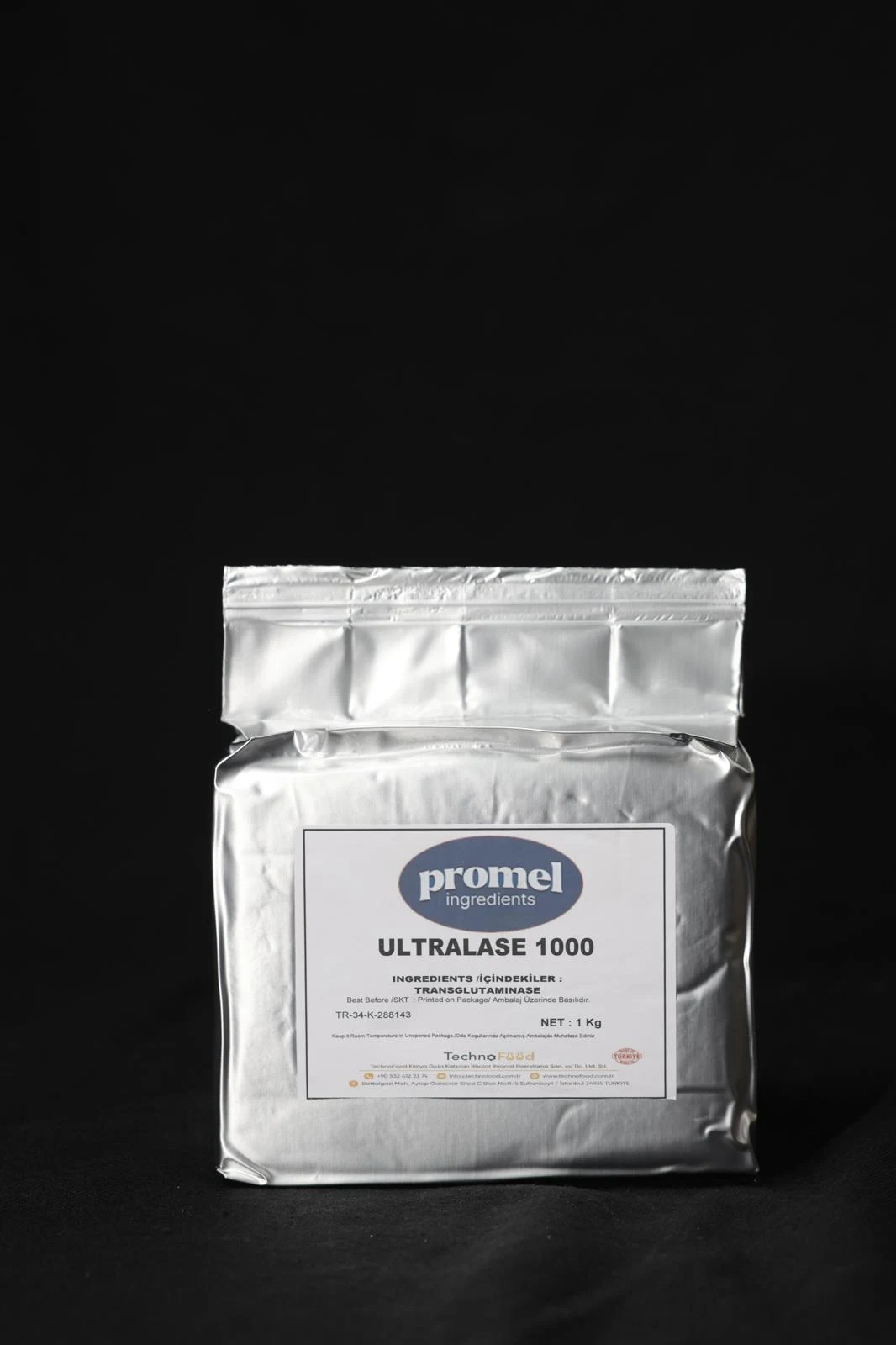
PROMEL ULTRALASE-1000
Promel Ultralase-1000 is a microbial transglutaminase preparation that forms covalent cross-links between milk proteins, increasing viscosity, reducing syneresis and improving texture in fermented milk products.
Product description
Promel Ultralase-1000 is a transglutaminase (TG) enzyme preparation specifically designed for the dairy industry, used for texture improvement in food processing. It is supplied in powder form; it contains dextrose as a carrier and a sunflower oil coating to reduce dusting. The enzyme strengthens the protein network in products such as yogurt, fermented milk products, cheese, cream and ice cream, helping to reduce the need for stabilisers or additional milk powder.
Technical function and working principle
Transglutaminase (protein-glutamine γ-glutamyltransferase) catalyses an acyl transfer reaction between the γ-carboxamide group of a glutamine residue and the ε-amino group of a lysine residue in proteins. The result is the formation of ε-(γ-glutamyl)lysine isopeptide bonds between and within protein molecules, with ammonia released as a by-product. These covalent bonds are resistant to thermal and mechanical processing.
Among milk proteins, caseins are the best substrates; β- and κ-casein in particular are readily cross-linked owing to their open and flexible structures. Native serum proteins (β-lactoglobulin, α-lactalbumin) are more difficult to cross-link, but can participate in the reaction once denatured by heat treatment. In acid gels (yogurt), the cross-linked protein network forms a more homogeneous and dense structure, resulting in higher gel firmness, higher viscosity and reduced serum separation (syneresis).
Applications
- Set and stirred yogurt, strained yogurt, ayran (yogurt drink) and drinkable fermented milk products
- Texture compensation in low-fat and fat-free yogurts
- Fresh cheeses, cream cheese and labneh-type products
- Body and melt resistance in ice cream and milkshake mixes
- Milk stabiliser systems and plant-based (vegan) cheese alternatives
Benefits
- Increased viscosity and gel firmness in yogurt
- Reduced serum separation (syneresis) and a more stable appearance throughout shelf life
- Potential reduction in the need for added milk powder, caseinate or hydrocolloid
- Full mouthfeel in low-fat products
- Yield support through improved serum protein retention in the curd under suitable process conditions
- Covalent bonds resistant to thermal and mechanical processing
Usage and dosage
The specification states dosage in accordance with good manufacturing practice (GMP). In practice the enzyme quantity is calculated on the basis of activity units per gram of protein (U/g protein); yogurt studies typically examine levels of a few U/g protein. Overdosing can lead to a hard, rubbery or grainy texture and make the curd brittle.
In yogurt the most common method is to add the enzyme to heat-treated milk that has been cooled to incubation temperature, together with or shortly before the culture. The enzyme remains active during fermentation until the pH drops; in some applications the milk is first held with the enzyme at 40–50 °C for a defined period, after which the enzyme is inactivated by heat treatment and the culture is added. The enzyme powder should be dispersed in a small amount of water or milk before addition to prevent clumping.
In cheese, adding the enzyme before the rennet can affect the breakdown of casein by chymosin (κ-casein hydrolysis) and delay coagulation; timing and dosage in cheese applications must therefore always be validated at pilot scale. The optimum dosage should be determined through pilot trials according to the raw material and formulation.
Technical specifications
| Parameter | Value |
|---|---|
| Appearance | Powder |
| Colour | White to cream |
| Composition | Transglutaminase preparation; dextrose carrier, sunflower oil coating |
| Heavy metals (as Pb) | Max. 5 ppm |
| Antibiotics | Negative |
| Coliforms | < 30 MPN/g |
| E. coli (25 g) | Not detected |
| Salmonella (25 g) | Not detected |
| Allergens | Free from substances listed as EU allergens |
| GMO labelling | No GMO labelling required under EU Regulations 1829/2003 and 1830/2003 |
| Halal compliance | Compliant with OIC/SMIIC 1:2019 |
Packaging and storage
1 kg aluminium foil pouch; 10 pouches per carton. Store in original, unopened packaging in a dry, cool place, preferably below 25 °C. Shelf life is 18 months from the date of manufacture. Once opened, reseal tightly to prevent moisture uptake. Please check the applicable regulations to verify whether the product is permitted for use in your application.
Frequently asked questions
Does transglutaminase completely replace stabiliser in yogurt?
In many formulations it allows a reduction in stabiliser or milk powder levels; whether they can be removed entirely depends on the target texture, dry matter and shelf-life requirements and must be verified through pilot trials.
What happens if the dosage is too high?
Excessive cross-linking can make the product rubbery and grainy; in stirred yogurt, smoothness is lost. Dosage should therefore be determined by incremental increases based on the protein content.
Does the enzyme remain active in the finished product?
Transglutaminase is inactivated by heat. In products that do not undergo heat treatment after fermentation, low pH and cold storage largely limit activity; an inactivation step should be evaluated depending on the product type.
Is it halal compliant?
The raw material specification indicates compliance with the OIC/SMIIC 1:2019 standard. A copy of the certificate is available on request.
Technical support
For assistance in determining the correct dosage and addition point of Ultralase-1000 in your yogurt, cheese or ice cream formulation, as well as pilot trial planning and sample requests, please contact the Technofood technical team.
Applications
ICE CREAM and MILK SHAKE · VEGAN CHEESES · FERMENTED DAIRY PRODUCTS · MILK STABILIZERS