

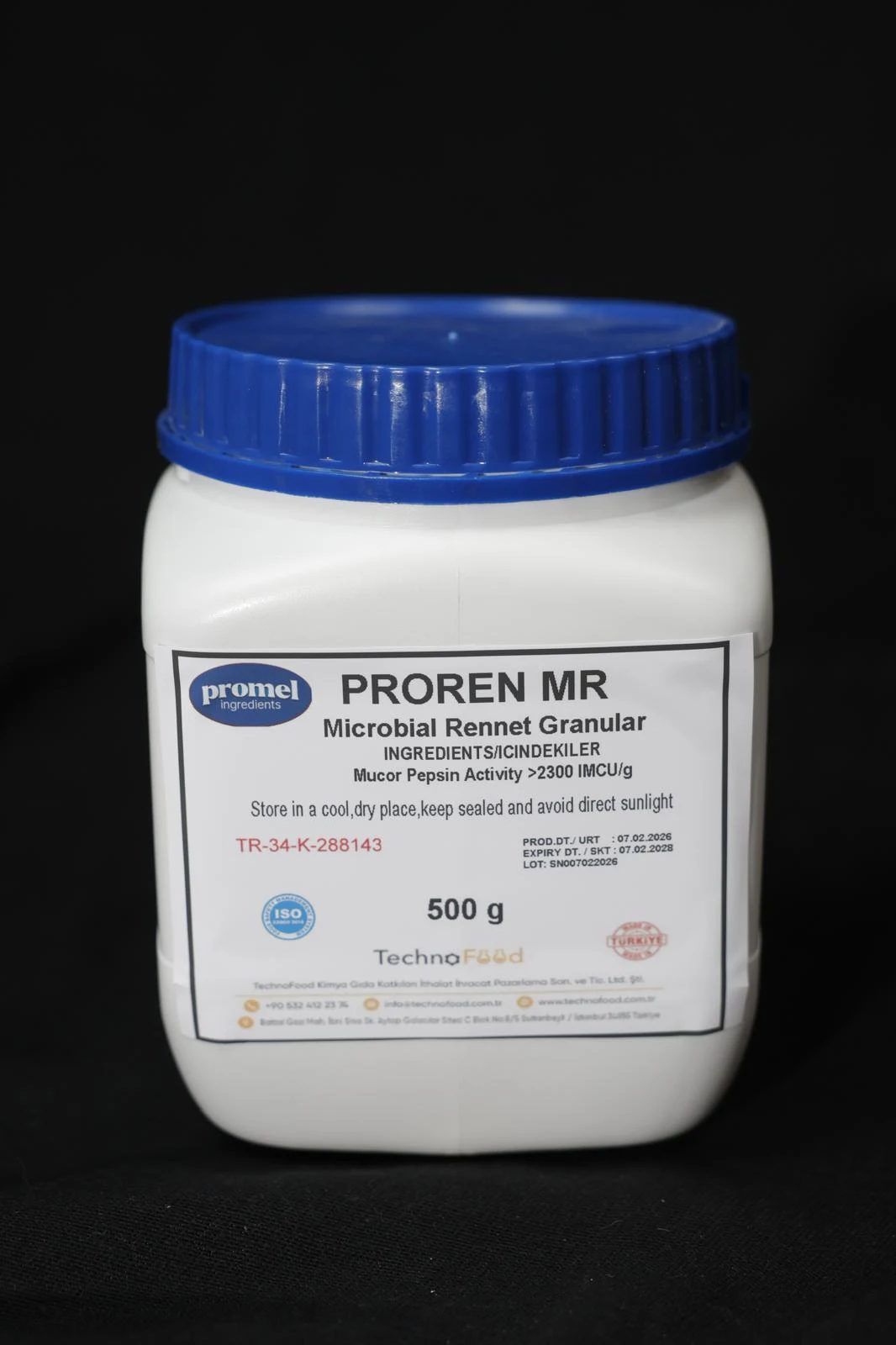
PROREN FERMENTED CHYMOSIN 500 GR
Proren is a powder (granular) rennet containing chymosin produced by Kluyveromyces lactis fermentation; it coagulates with high specificity, supporting cheese yield and consistent ripening. Available in 500 g packs.
Product description
Proren is a powdered rennet containing fermentation-produced chymosin (FPC) used to coagulate milk in cheese production. Chymosin (EC 3.4.23.4) is the principal milk-clotting enzyme naturally found in the calf abomasum. In fermentation-produced chymosin, the same enzyme is produced and purified through controlled fermentation of Kluyveromyces lactis yeast. This provides a high-purity, consistent-quality coagulant independent of animal-derived sources.
The powder form offers higher concentration and a longer shelf life compared with liquid rennet; the required quantity is dissolved in water immediately before use.
Technical function and operating principle
Milk coagulation occurs in two stages. In the enzymatic stage, chymosin cleaves κ-casein — the protein that stabilises the surface of casein micelles — at the Phe105–Met106 bond; the hydrophilic caseinomacropeptide is released into the serum, leaving paracasein behind. In the second stage, in the presence of sufficient calcium and at an appropriate temperature, paracasein micelles aggregate to form the curd (gel).
The quality of a rennet is assessed by the ratio of its clotting activity to its general proteolytic activity (C/P ratio). Chymosin exhibits high specificity towards κ-casein and hydrolyses other casein fractions only to a limited extent. Low non-specific proteolysis reduces protein and fat losses into the whey, preserves yield and lowers the risk of bitterness during ripening. In published studies, cheese yield with fermentation-produced chymosin has been found practically equivalent to calf rennet and higher than with certain microbial proteases.
Rennet strength is expressed in international milk-clotting units (IMCU). The IMCU value defines the amount of enzyme required to coagulate a given quantity of standard milk under standard conditions and serves as the basis for dosage calculations.
Applications
- White brined cheese and brine-ripened cheeses
- Kashar cheese and pasta filata type cheeses
- Hard and semi-hard ripened cheeses
- Fresh cheeses, labneh and spreadable cheese bases
- Production of raw material (curd formation) for processed cheese
Key benefits
- Yield preservation through a high clotting-to-proteolysis ratio
- Reduced risk of bitterness during ripening
- Consistent activity and reproducible clotting time from batch to batch
- Animal-source-independent production; suitable for vegetarian use
- High concentration in powder form and convenient stock management
Usage and dosage
Immediately before use, dissolve the required quantity in approximately 10–20 times its volume of cold, chlorine-free drinking water and add it to the milk in a thin stream with thorough stirring. The water must be chlorine-free, as chlorine and high pH can inactivate the enzyme; the solution should not be left to stand. After rennet addition, the milk must remain undisturbed until coagulation begins.
Renneting is typically carried out at 30–37 °C; the coagulation time varies with temperature, pH, calcium level and rennet dosage. In pasteurised milk, the addition of calcium chloride improves curd firmness. The required amount of rennet is calculated based on the product's IMCU strength and the target coagulation time. Optimum dosage should be determined through pilot trials according to the raw material and formulation.
Technical specifications
| Parameter | Value |
|---|---|
| Appearance | Granular powder |
| Colour | Cream to light brown |
| Odour | Slight fermentation odour |
| Solubility | Readily soluble in cold water |
| Enzyme | Chymosin (EC 3.4.23.4), produced by K. lactis fermentation |
| Total viable count | < 1,000 CFU/g |
| Moulds and yeasts | ≤ 10/g |
| Coliforms | ≤ 10/g |
| Anaerobic sulphite-reducing bacteria | ≤ 30/g |
| E. coli / Listeria monocytogenes | Not detected in 25 g |
| Staphylococcus aureus | Not detected in 1 g |
| Halal compliance | Compliant with OIC/SMIIC 1:2019 |
Packaging and storage
Supplied in food-grade plastic containers, 500 g pack. Store in a dry, cool place, tightly sealed, at refrigeration temperature; protect from direct sunlight.
Occupational safety
Enzyme powders may cause sensitisation if inhaled. Avoid generating dust during weighing and dissolving, and use appropriate respiratory protection. Detailed information is provided in the safety data sheet (SDS).
Frequently asked questions
What is the difference between fermentation-produced chymosin and microbial rennet?
Microbial rennets are proteases derived from certain moulds and differ from chymosin; they exhibit higher general proteolytic activity. Fermentation-produced chymosin is identical to calf chymosin; its higher specificity results in lower yield loss and reduced risk of bitterness.
What should I check if coagulation is slower than expected?
Check the milk temperature, pH, calcium level and the way the rennet solution was prepared. Chlorinated water or a solution left standing for too long will cause loss of activity.
Is it halal compliant?
The product description states compliance with the OIC/SMIIC 1:2019 standard. A copy of the certificate is available upon request.
Technical support
For optimisation of your renneting programme, dosage calculations and curd-cutting time with Proren, as well as sample requests, please contact the Technofood technical team.