

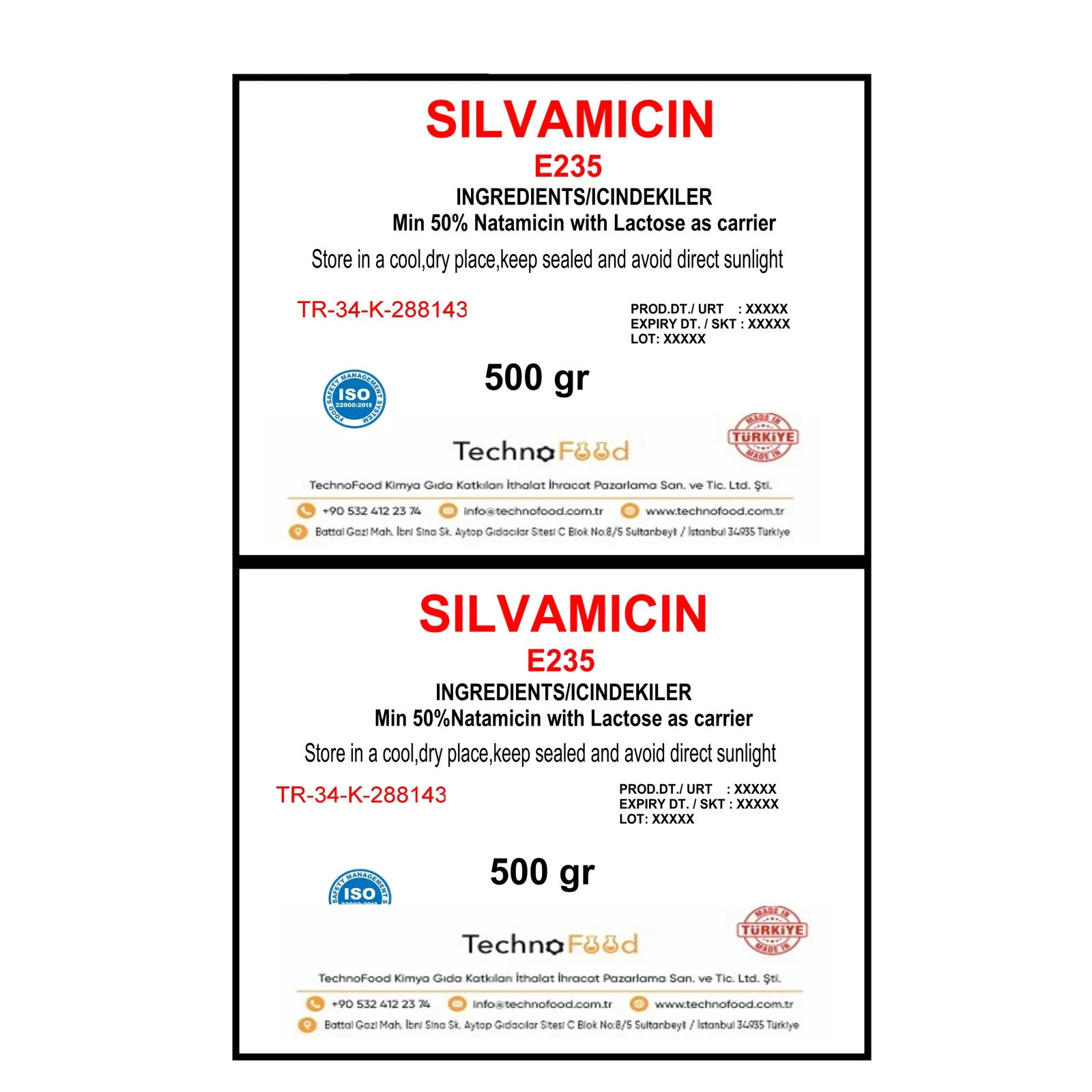
SILVAMYCIN NATAMYCIN
Silvamycin is a powdered preservative produced by Streptomyces natalensis fermentation, containing at least 50 % natamycin (E235); it inhibits the growth of moulds and yeasts on the cheese surface without affecting ripening cultures.
Product description
Silvamycin is the natamycin (pimaricin)-based product in the Promel Sylva preservative range. Natamycin is a natural antifungal compound with a polyene macrolide structure, produced by aerobic fermentation of the bacterium Streptomyces natalensis. The product is a light yellow to cream-coloured crystalline powder containing at least 50 % natamycin; the remainder is carrier. This standardisation simplifies dosage calculations when preparing application solutions and suspensions.
In cheese ripening rooms, moulds that develop on the rind and surface cause both visual defects and product losses as well as mycotoxin risks. Silvamycin addresses this problem through surface application.
Technical function and mode of action
Natamycin binds specifically to ergosterol present in the cell membranes of moulds and yeasts. This binding disrupts the function of nutrient transporters on the membrane and halts cell growth. Because bacterial cell membranes do not contain ergosterol, natamycin has no effect on bacteria. This selectivity is a major advantage in cheese technology: lactic acid bacteria, propionic bacteria and the ripening flora within the cheese remain unaffected, while undesirable moulds and yeasts on the surface are suppressed.
Natamycin has very low water solubility; consequently, its diffusion into the cheese mass is limited and it remains on the surface, providing long-lasting protection. It is effective against the majority of moulds and yeasts at very low concentrations (generally in the range of 1–10 mg/kg as stated in the specification).
Applications
- Rind and surface protection of hard and semi-hard cheeses (kashar, Gruyère, tulum types)
- Cheese rind protection by incorporation into coating emulsions
- Sliced, shredded cheeses and other product categories (where permitted by legislation)
- Mould load reduction programmes in storage rooms, shelving and packaging environments
Benefits
- High efficacy against moulds and yeasts at very low dosage
- Preserves the ripening flora as it does not affect bacteria
- Long-lasting surface protection thanks to low solubility
- Reduced rind and product losses caused by mould
- No impact on taste, odour or colour
- Standardised at minimum 50 % natamycin for easy dosage calculation
Usage and dosage
In cheese applications, natamycin is typically applied as an aqueous suspension by dipping, spraying or brushing, or by incorporation into a cheese coating emulsion. Suspension concentrations commonly range from 0.1 to 0.5 g/L natamycin; the fact that the product contains 50 % natamycin must be taken into account. The suspension should be stirred continuously to maintain homogeneity and prepared fresh daily; natamycin is sensitive to light, oxidants and strongly acidic conditions.
From a regulatory standpoint, EU Regulation 1333/2008 and the Turkish Food Codex Food Additives Regulation permit the use of natamycin on hard, semi-hard and semi-soft cheeses only as a surface treatment: a maximum of 1 mg/dm² on the surface, and it must not be present at a depth of 5 mm. The current legislation of the country where the product is to be applied must always be verified. The optimum dosage and application method should be determined through pilot trials based on the specific product and storage conditions.
Specifications
| Parameter | Value |
|---|---|
| Appearance | Light yellow to cream, crystalline powder |
| Natamycin content | Min. 50 % |
| Loss on drying | Max. 8 % |
| pH | 5.00 – 7.50 |
| Total plate count | Max. 100 CFU/g |
| Moulds and yeasts | Max. 10 CFU/g |
| E. coli | Negative in 25 g |
| Salmonella | Negative in 100 g |
| Staphylococcus aureus | Negative in 25 g |
Packaging and storage
5 kg carton packaging. Store in a cool, dry place with the packaging sealed, protected from direct sunlight. Shelf life is 24 months.
Frequently asked questions
Does natamycin affect the cultures inside the cheese?
No. Natamycin only affects cells containing ergosterol, i.e. moulds and yeasts; lactic acid bacteria and propionic bacteria are not affected.
Can natamycin be added to the cheese milk?
No. Legislation permits only surface application on cheeses. Bacterial issues such as late blowing within the cheese mass should be addressed with other preservatives such as lysozyme or nisin.
How to choose between natamycin and potassium sorbate?
Natamycin is effective at very low dosages, does not affect the taste of the cheese and remains on the surface. Sorbate requires higher dosages and its efficacy is pH-dependent; the product categories permitted by legislation also differ. The choice depends on the product type and regulatory limits.
Why does the suspension settle?
Natamycin has very low water solubility and exists in suspension form. Continuous stirring in the application tank and daily fresh preparation are essential for homogeneous dosing.
Technical support
For the appropriate suspension concentration of Silvamycin for your cheese type, incorporation into coating emulsions and a regulatory-compliant application plan, please contact the Technofood technical team.
Applications
HARD AND SEMI-HARD CHEESES · SPREADABLE CHEESES · SAUCES · VEGAN CHEESES · FERMENTED DAIRY PRODUCTS · PRESERVATIVES