

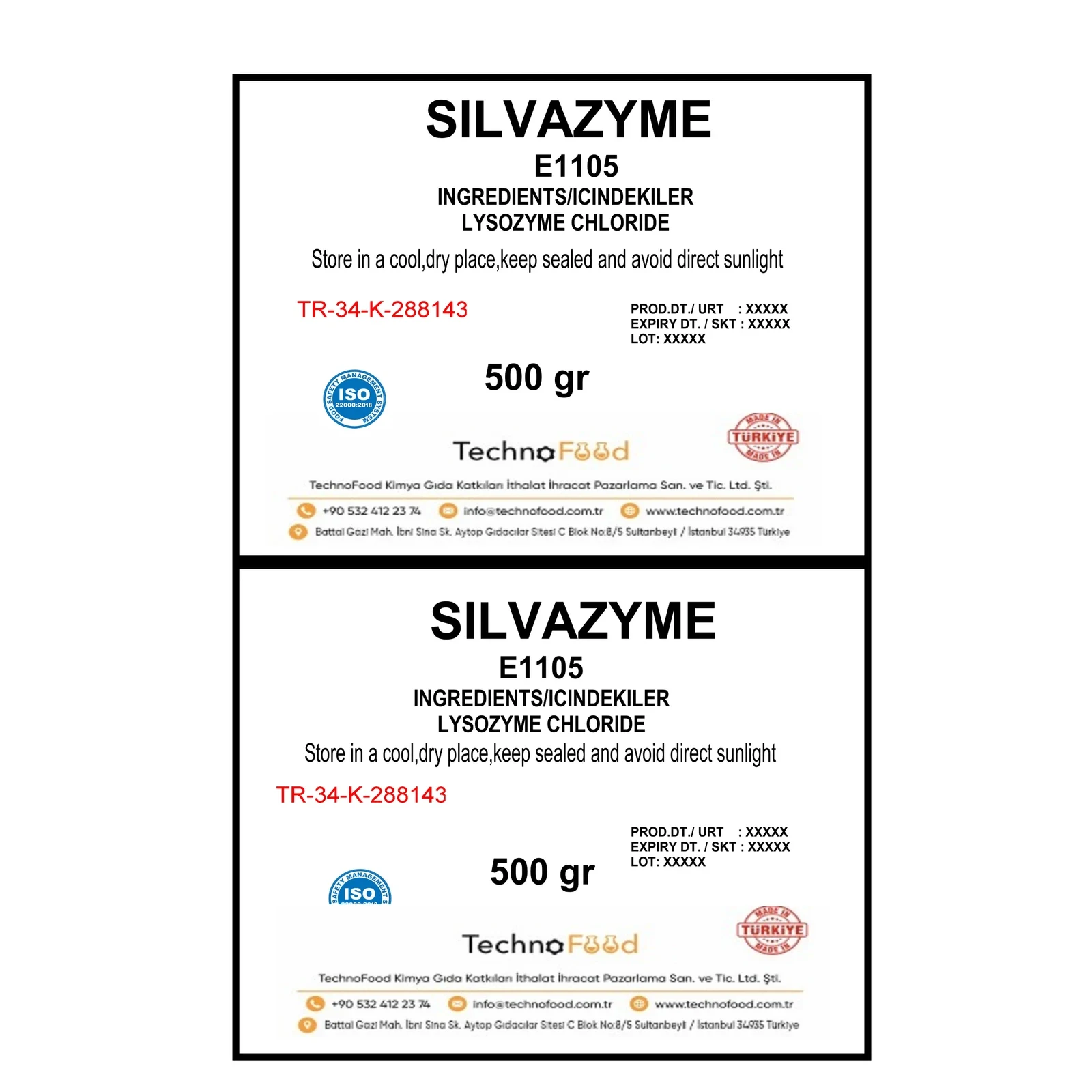
SILVAZYME LYSOZYME
Silvazyme is a lysozyme (E1105) enzyme preparation added to cheese milk to prevent late blowing defects caused by Clostridium tyrobutyricum; developed for ripened hard and semi-hard cheeses.
Product description
Lysozyme (muramidase, EC 3.2.1.17) is a naturally occurring enzyme that degrades bacterial cell walls. Classified as food additive E1105, it is commercially obtained from hen egg white. Silvazyme is the lysozyme-based product in the Promel Sylva preservative range, used in cheese technology specifically to combat the late blowing defect.
Late blowing is a serious quality defect in ripened hard and semi-hard cheeses that can appear weeks or even months after production, manifesting as large irregular eyes, cracks, rind splitting and a pungent butyric acid off-odour. The primary causative agent is Clostridium tyrobutyricum spores, which enter the milk via silage and feed. These spores survive pasteurisation.
Technical function and mode of action
When Clostridium spores germinate in cheese and convert to vegetative cells, they ferment lactate to produce butyric acid, CO₂ and hydrogen gas. The gas creates cracks in the cheese mass, while butyric acid imparts off-flavours and off-odours. Lysozyme hydrolyses the β(1→4) glycosidic bonds between N-acetylmuramic acid and N-acetylglucosamine in the peptidoglycan wall of the vegetative cell, thereby inhibiting the growth of newly germinated cells.
Lysozyme is largely retained in the curd and remains active throughout ripening. Because most lactic acid bacteria are relatively resistant to lysozyme, starter culture activity is generally not significantly affected. Lysozyme does not act on dormant spores; its effect occurs after germination. Keeping the spore load in milk low (through feed hygiene, bactofugation and microfiltration) should therefore be part of the overall preventive system.
Applications
- Ripened hard cheeses (Gruyère, Grana types, kashar)
- Semi-hard cheeses (Gouda, Edam types)
- Other long-ripened cheeses at risk of butyric fermentation
Benefits
- Prevention of late blowing, cracks and butyric off-odour caused by Clostridium tyrobutyricum
- Reduced product and quality losses during extended ripening
- Minimal impact on starter culture activity
- A naturally derived alternative to nitrate (E251/E252)
- No adverse effect on cheese taste and flavour
Usage and dosage
Lysozyme is added to cheese milk before coagulation, at the same stage as starter culture inoculation; it is recommended to dissolve it in a small amount of water for even distribution. The dose commonly used in the literature and in practice is approximately 25 mg lysozyme per litre of milk (approx. 500 units/mL milk). This dose has been reported to be effective when the spore count in the milk is low (in the range of a few hundred spores per litre); at high spore loads it may not be sufficient on its own.
The Turkish Food Codex Food Additives Regulation and EU Regulation 1333/2008 permit the use of lysozyme in ripened cheeses under the quantum satis principle. Because lysozyme is egg-derived, egg allergen declaration on the final product label is mandatory. The optimum dosage should be determined by pilot trials based on the spore load in the milk, the cheese type and the ripening period.
The technical data sheet (TDS) is available on request.
Packaging and storage
Enzyme preparations are typically stored in a cool, dry place in sealed packaging. For packaging and shelf life details, please contact our technical team.
Frequently asked questions
Does lysozyme affect rennet or starter cultures?
It has no effect on chymosin. Most lactic acid bacteria are resistant to lysozyme; however, since some strains may be sensitive, any new culture–lysozyme combination should be validated at pilot scale.
What is the difference between lysozyme and nisin?
Lysozyme is added to cheese milk for ripened cheeses to target Clostridium tyrobutyricum and is compatible with starter cultures. Nisin, which can also inhibit lactococci, is used predominantly in heat-treated products such as processed cheese.
Is allergen declaration required on the label?
Yes. Because lysozyme is derived from egg white, its egg origin must be clearly highlighted in the ingredients list of the final product.
Does lysozyme completely eliminate late blowing?
Lysozyme provides a significant safeguard but may not be sufficient on its own if the spore load in the milk is high. It delivers the best results when combined with good feed hygiene and, where necessary, mechanical spore removal.
Technical support
For determining the appropriate Silvazyme dosage for your cheese type and milk spore load, as well as for labelling guidance and sample requests, please contact the Technofood technical team.
Applications
HARD AND SEMI-HARD CHEESES · SPREADABLE CHEESES · VEGAN CHEESES · FERMENTED DAIRY PRODUCTS · PRESERVATIVES